
Why Learning Medical Terminology Matters
As you step into the world of healthcare, you’ll discover that you’re practically learning a whole new language! From handling patient charts to knowing emergency codes, medical terminology is everywhere, and getting comfortable with it early in your education journey will make your life a lot easier. Think of it as learning the secret handshake of the healthcare world. The better you know it, the smoother your day-to-day tasks will be.
At Osmosis, we make learning medical terminology easier with active learning strategies, including the use of flashcards and spaced repetition to help you lock in key terms. Ready to dive in? Let’s break it down into bite-sized, practical sections you can use every day in your healthcare training.

Breaking Down Medical Terms
Have you ever seen a medical term like hyperglycemia and had no clue what it meant? Don’t worry! Once you get the hang of understanding the parts of each term (the standard elements used to construct medical terms), you’ll be able to decode complex medical terms like a pro!
- Word Roots are the foundation of medical terms and indicate the body part or function they describe. Examples of word roots include cardio- (heart), neuro- (nerves), gastro- (stomach), and hemo- (blood).
- Prefixes modify the meaning of a word by indicating a condition, number, or position. Examples of prefixes include hyper- (too much), hypo- (too little), brady- (slow), and tachy- (fast).
- Suffixes added to the end of a word describe a condition, disease, or procedure. Examples of suffixes include -itis (inflammation), -ectomy (removal), and -ology (study of something).
Let’s explore word roots, prefixes, and suffixes to help decipher the meanings of medical terms!
Word Roots (Body Parts & Functions)
- Angi(o), Vas(o) – Relates to blood vessels. Used in terms like angioplasty, a procedure to open a blocked blood vessel, and vasoconstriction, which refers to the narrowing of blood vessels.
- Bucc(o) – Refers to the cheek. An example is buccal mucosa, which is the lining inside the cheek.
- Cardi(o) – Refers to the heart. An example of this root is cardiomyopathy, a disease that affects heart muscle function.
- Crani(o) – Relates to the skull. An example of this root is craniotomy, a surgical procedure that involves opening the skull.
- Cyst(o) – Refers to the bladder. An example of this root is interstitial cystitis, which denotes inflammation of the bladder.
- Hemat(o) – Relates to blood. Examples include hematology, the branch of medicine that studies blood, blood-forming organs (like bone marrow), and blood-related disorders.
- My(o) – Refers to muscle. Examples include cardiomyopathy, which is a chronic disease of the heart muscle.
- Nephr(o), Ren(o) – Relates to the kidneys. Examples include nephrectomy, the surgical removal of a kidney, and renal function, which pertains to kidney function.
- Neur(o) – Refers to nerve. Used in terms like neuropathy, which is when nerve damage disrupts signals between the brain and the rest of the body causing pain, tingling, and discomfort.
- Oste(o) – Relates to bone. Used in terms like osteoporosis, a bone disease that makes bones thin, weak, and brittle, causing them to break easily.
- Ot(o), Auri, Aud – Pertains to the ear. This root refers to terms like otitis media, which is a middle ear infection, and the term auricle, referring to the outer ear.
- Pulmon(o) – Refers to the lungs. Examples include pulmonary embolism, a condition where a blood clot travels to the lungs and blocks a pulmonary artery, cutting off blood flow and oxygen to part of a lung.
- Thorac(o) – Relates to the chest. An example of the use of this root is thoracotomy, which is a surgical incision into the chest wall.
- Thromb(o) – Pertains to blood clots. An example of the use of this root is thrombosis, which is the formation of a clot inside a blood vessel.
- Hepat(o) – Refers to the liver. This root appears in terms like hepatomegaly, which indicates an enlarged liver.
- Gastr(o) – Related to the stomach. An example of this root is gastroenteritis, which signifies inflammation of the stomach.
Prefixes (Modifying Terms)
- A-/An- – Without. As in sleep apnea (when breathing repeatedly stops and starts during sleep).
- Bi- Two. As in bilateral (affecting or occurring on both sides of the body)
- Brady- Slow. As in bradycardia (slow heart rate).
- Tachy- Fast. As in tachypnea (rapid breathing).
- Hypo- Below normal. As in hypoglycemia (low blood sugar).
- Hyper- Above normal. As in hypertension (high blood pressure).
- Inter- Between. As in intercostal muscles (muscles between the ribs).
- Oligo- Few/scanty. As in oliguria (production of small amounts of urine).
- Poly- Many. As in polyuria (production of large amounts of dilute urine).
- Post- After. As in postpartum (after childbirth) or postoperative (after surgery).
- Pre- Before. As in preoperative (before surgery).
- Sub- Below. As in subcutaneous injection (an injection under the skin).
- Uni- One. As in unilateral (affecting or occurring on only one side of the body).
Suffixes (Describing Conditions & Procedures)
- -algia – Indicates pain, e.g., neuralgia (nerve pain).
- -ectomy – Refers to surgical removal, e.g., appendectomy (removal of the appendix).
- -emia – Refers to a blood condition, e.g., anemia (a lower-than-normal number of healthy red blood cells (RBCs) or less hemoglobin).
- -itis – Indicates inflammation, e.g., bronchitis (inflammation of the bronchial tubes).
- -megaly – Means enlargement, e.g., hepatomegaly (enlarged liver) or acromegaly, a rare condition that causes some bones, organs, and other tissue to grow.
- -oma – Means tumor, e.g., carcinoma (a type of cancerous tumor) or melanoma (skin cancer).
- -osis – Indicates an abnormal condition, e.g., cyanosis (a bluish discoloration of the skin due to low oxygenation or poor circulation).
- -pathy – Refers to disease, e.g., neuropathy (disease affecting the nerves).
- -rrhea – Means flow or discharge, e.g., diarrhea (loose, watery stool paired with frequent, often urgent, bowel movements).
- -scope – Refers to an instrument for viewing, e.g., endoscope, (a device for viewing inside the body).
- -uria – Refers to a urine condition, e.g., hematuria (the presence of blood in the urine).

Nursing Essentials
Core Nursing Responsibilities
- Charge Nurse – The nurse who oversees staff and patient care in a hospital unit during a shift.
- Clinicals – Hands-on nursing training in hospitals or clinics, where students practice under supervision.
- Charting – Recording patient information in an electronic health record, which is essential for tracking patient progress.
- Rounds – Nurses and doctors periodically check on patients throughout the day to monitor their condition.
A Few Common Nursing Procedures
- Catheterization: Inserting a tube to drain urine from the bladder.
- IV Therapy: Delivering fluids or medication directly into a vein.
- Intubation: Inserting a breathing tube into the airway to assist with ventilation.
- Suctioning: Removing mucus or fluids from the airway to help patients breathe.
Core Medical Responsibilities
- Attending Physician – The doctor responsible for overseeing patient care and supervising residents and medical students during a clinical shift or rotation.
- Clinical Rotations – Hands-on medical training in hospitals or clinics where medical students and residents practice patient care under supervision.
- Documentation – Recording patient history, examination findings, diagnostic results, and treatment plans in the electronic health record to ensure continuity of care.
- Rounds – Physicians, often with the healthcare team, conduct regular visits to patients to assess progress, adjust treatment, and coordinate care.
A Few Common Medical Procedures
- Physical Examination: Systematic assessment of the patient’s body to evaluate health status and identify any abnormalities.
- Central Line Placement: Inserting a catheter into a large central vein for medication administration, hemodynamic monitoring, or fluid management.
- Lumbar Puncture: Inserting a needle into the spinal canal to collect cerebrospinal fluid for diagnostic testing or to administer medication.
- Paracentesis: Using a needle to remove excess fluid from the abdominal cavity for diagnosis or symptom relief.
- Thoracentesis: Removing fluid or air from the pleural space around the lungs to diagnose or treat respiratory conditions.
- Joint Injection/Aspiration: Injecting medication into or withdrawing fluid from a joint space to diagnose or treat joint disorders.
Vital Signs and Monitoring
- Heart Rate (HR): the number of times the heart beats per minute, used to assess cardiovascular health.
- Respiratory Rate (RR): how many breaths a person takes per minute, indicating respiratory function.
- Blood Pressure (BP): measurement of the force of blood against artery walls, essential for diagnosing hypertension or hypotension.
- Oxygen Saturation (SpO2): the percentage of oxygen in the blood, measured using a pulse oximeter.
Emergency and Surgical Terms
- Code Blue indicates a life-threatening emergency used when a patient has a cardiac arrest.
- Pre-op relates to the care given before surgery, including preparation and patient education.
- Post-op is the recovery and monitoring period after surgery to prevent complications.
- Triage is a method of prioritizing patients based on the severity of their condition.

Some Acronyms & Abbreviations Every Healthcare Professional Should Know
Taking the time to learn and understand the following acronyms and abbreviations is crucial for every healthcare professional because they help streamline communication, which enhances patient care. Let’s go over some must-know building blocks of medical terminology.
General Patient Care Acronyms
- A&Ox4 – Assesses mental status; is the patient alert and oriented to person, place, time, and situation?
- BID – Relates to medication scheduling twice a day (bis in dies).
- TID – Defines medication scheduling to three times a day.
- QID – Relates to medication scheduling four times a day.
- HS – Denotes scheduling medication for bedtime.
- DNR – Do not resuscitate is a medical order indicating that no life-saving measures should be taken.
- EHR – Electronic health record; a digital version of a patient’s medical history.
- IV – Intravenous, delivering medication directly into the bloodstream.
- NPO – Refers to when a patient is not allowed to eat or drink before surgery.
- OTC – Over-the-counter medication refers to drugs available without a prescription.
- PRN – Pro re nata indicates that medication should only be given when necessary or as needed.
- SOB – Shortness of breath. A common symptom in respiratory distress.
- VS – Vital signs include heart rate, blood pressure (BP), temperature, and respiratory rate.
- CBR – Complete bed rest, requiring a patient to remain in bed for a designated period.
- BRP – Bathroom privileges: A patient can use the bathroom while resting.
- OOB – Out of bed; a patient being allowed or encouraged to get up.
- WNL – Within normal limits; used to indicate lab results or exam findings are in a normal range.
Medications & Treatments
- IM – Intramuscular
- SC/SQ – Subcutaneous
- NSAID – Nonsteroidal anti-inflammatory drug
- ASA – Acetylsalicylic acid (aspirin)
- ABX – Antibiotics
- C&S – Culture and sensitivity (infection test)
Tests & Procedures
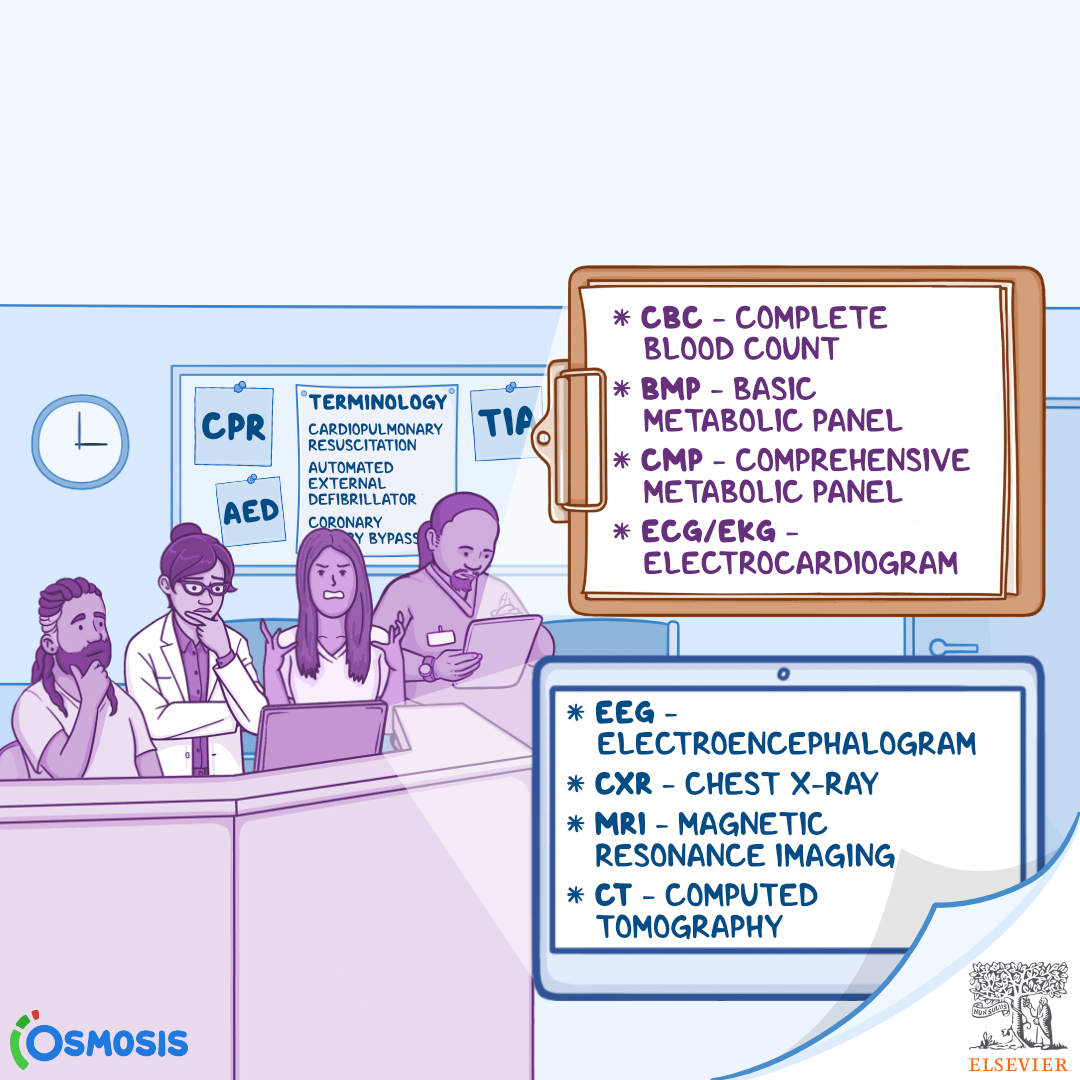
- CBC – Complete blood count
- BMP – Basic metabolic panel
- CMP – Comprehensive or complete metabolic panel
- ECG/EKG – Electrocardiogram, a test to record the heart’s electrical activity.
- EEG – Electroencephalogram, a test to record the heart’s electrical activity
- CXR – Chest X-ray
- MRI – Magnetic resonance imaging
- CT – Computed tomography; X-rays of detailed cross-sectional images of the body
- LP – Lumbar puncture (also known as a Spinal Tap)
Emergency & Life-Saving Acronyms
- CPR – Cardiopulmonary resuscitation
- AED – Automated external defibrillator
- STAT – Immediately
- ABC – Airway, breathing, circulation (first steps in emergencies)
- CABG – Coronary artery bypass graft
- CVA – Cerebrovascular accident (stroke)
- TIA – Transient ischemic attack (mini-stroke)
- MI – Myocardial infarction (heart attack)
Final Thoughts: Make Medical Terminology Work for You
Learning all this new lingo may feel overwhelming, but with the right approach, you’ll pick it up faster than you think possible. Take time to study these new terms using flashcards, practice using key medical terms aloud, and employ them regularly on your patient charts to reinforce your learning. With these key terms under your belt, you’ll communicate clearly, document accurately, and work efficiently.

Key Takeaways
- Understand word roots, prefixes, and suffixes to decode medical terms.
- Learn common healthcare acronyms for clear and efficient communication.
- Become familiar with essential clinical procedures and their terminology.
- Use flashcards and practice to reinforce medical vocabulary.
- Mastery of terminology improves documentation and patient care quality.
You’re ready to start learning and speaking the language of healthcare like a pro!

Get your free trial now to find out why millions of current and future clinicians and caregivers love learning by Osmosis!


Leave a Reply