Adrenal insufficiency (Addison disease): Nursing
Definitions & Key takeaways
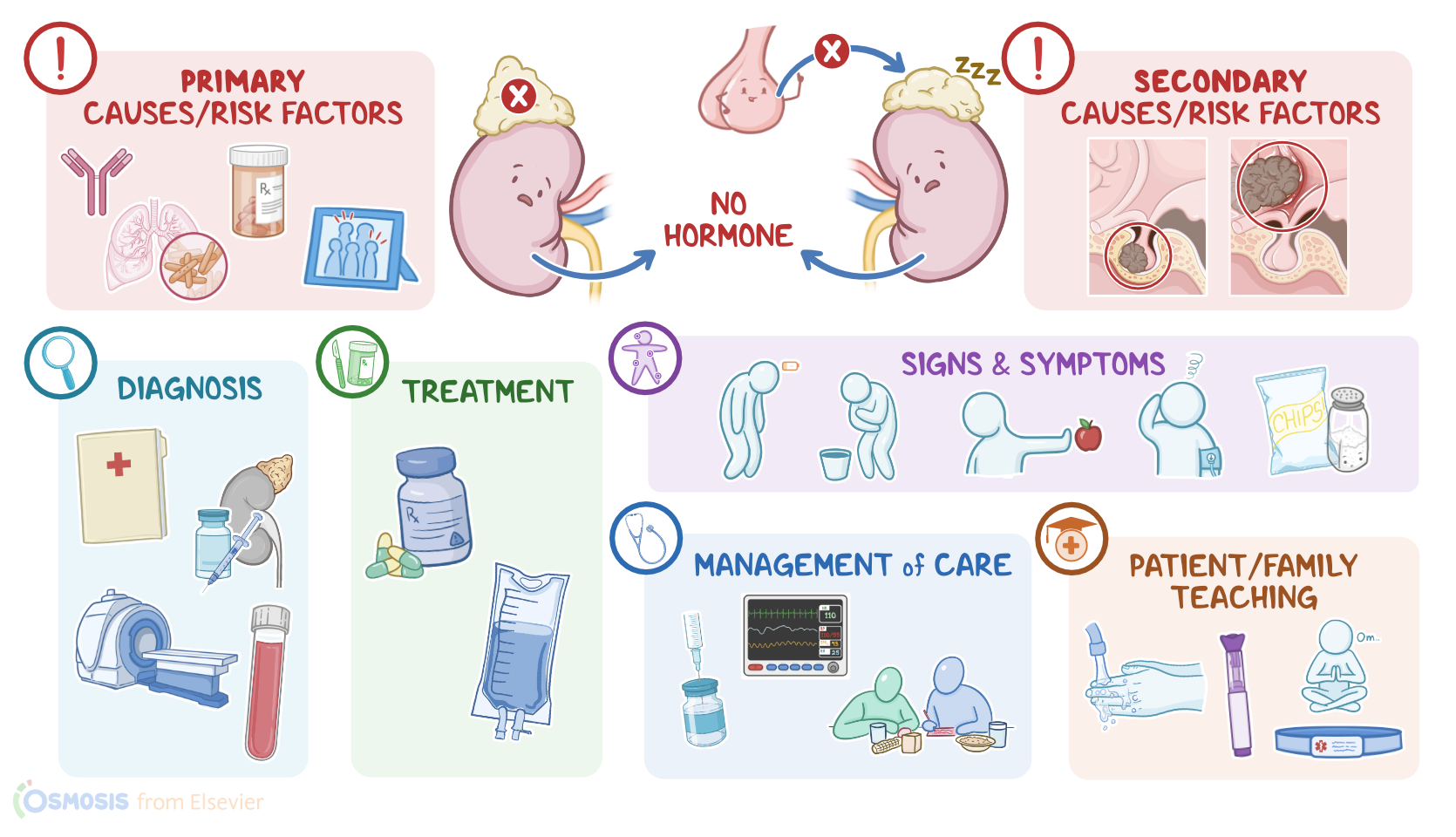
Adrenal insufficiency, also known as Addison disease, is a condition in which the adrenal glands do not produce enough hormones. Symptoms can include weakness, fatigue, weight loss, low blood pressure, and changes in mood and appetite.
Nursing implications for someone with adrenal insufficiency include monitoring their intake of fluids and sodium to prevent dehydration and low blood pressure; providing emotional support; assisting with activities of daily living; and providing education about the condition.
Introduction0:00–0:47
Adrenal insufficiency is an endocrine disorder that happens when the adrenal gland doesn’t produce enough hormones, particularly mineralocorticoids like aldosterone, glucocorticoids like cortisol, and androgens like testosterone.
It’s called “primary” when the underlying problem is localized to the adrenal gland itself, which can develop either acutely or chronically, and the chronic form is also known as Addison disease.
On the other hand, it’s called “secondary” when the pituitary gland doesn’t stimulate the adrenals enough to ensure adequate cortisol production.Now, let’s quickly review the anatomy and physiology of the adrenal glands.
Physiology0:47–3:31
There are two adrenal glands, one above each kidney, and each one has an inner layer called the medulla and an outer layer called the cortex.
Zooming in, the cortex is further subdivided into three more layers, namely the zona glomerulosa, zona fasciculata, and the zona reticularis.
And each of their functions can be easily remembered by thinking of the mnemonic Salt, Sugar, and Sex. So, the outermost layer is the zona glomerulosa, which secretes aldosterone.
Aldosterone is part of a hormone system called the renin-angiotensin-aldosterone system. Together, these hormones decrease potassium levels, increase sodium levels, and increase blood volume and blood pressure.
The middle layer is the zona fasciculata, and the cells there make the hormone cortisol as well as other glucocorticoids.
The hypothalamus, which is an almond-size structure which sits at the base of the brain, releases corticotropin-releasing hormone, or CRH for short, which acts on the pituitary gland, a pea-sized structure sitting just underneath the hypothalamus.
In response, the pituitary gland sends out adrenocorticotropic hormone, or ACTH for short, which stimulates the zona fasciculata to secrete more cortisol.
Now, cortisol is involved in a number of things such as maintaining glucose levels, blood pressure, suppression of the inflammatory and immune response, and it also seems to influence things like mood and memory.
Finally, the innermost layer is the zona reticularis, and cells there make sex hormones called androgens, including dehydroepiandrosterone, which is the precursor of testosterone.
So the adrenal glands are involved in testosterone production. In clients assigned male at birth, androgen levels are higher, and they’re responsible for the development of male reproductive tissues and secondary sex characteristics like facial hair and a large thyroid cartilage, also known as “Adam’s apple”.
The exact mechanism for adrenal androgen production is not well understood, but it seems to be stimulated by ACTH.Okay, now acute primary adrenal insufficiency can arise from Waterhouse-Friderichsen syndrome, which typically occurs as a complication of meningitis, where a sudden increase in blood pressure causes blood vessels in the adrenal cortex to rupture, filling up the adrenal glands with blood and causing tissue ischemia and adrenal gland failure.
Causes & Risk factors of primary adrenal insufficiency3:31–5:09
Acute insufficiency can also occur in clients undergoing adrenalectomy, or surgical removal of the adrenal glands. Chronic primary adrenal insufficiency is also called Addison disease, and in high-resource countries, the most common cause is autoimmune destruction, where the body’s own immune cells mistakenly attack the healthy adrenal cortical tissues.
In the rest of the world, the most common cause of Addison disease is tuberculosis. In this case the infection spreads from the lungs to the adrenal glands, causing inflammation and destruction of the adrenal cortex.
Other causes include metastatic carcinoma, which is where cancer spreads to the adrenal cortex from somewhere else in the body; HIV infection; medications like mitotane that inhibit adrenal cortisol production; and exposure to certain toxins.
Risk factors for developing adrenal insufficiency include the presence of autoimmune disorders, being less than 60 years of age, and having a family history for adrenal insufficiency or autoimmune disorders.
On the other hand, secondary adrenal Insufficiency is caused by hypopituitarism, which is when the pituitary doesn’t secrete a sufficient amount of hormones, including ACTH.
Causes & Risk factors of secondary adrenal insufficiency5:09–6:04
This is most often caused by large pituitary adenomas, which are benign tumors of the pituitary gland, or by large CNS tumors, like craniopharyngiomas, that compress healthy pituitary tissue.Other causes of insufficient ACTH secretion is head trauma, radiation, or surgery; as well as Sheehan syndrome, which refers to massive postpartum hemorrhage that causes pituitary ischemia and infarction, ultimately leading to hypopituitarism.
Finally, if the cause of hypopituitarism is unknown, it’s called idiopathic hypopituitarism.Okay, now regardless of the cause, when primary adrenal insufficiency occurs one or more layers of the adrenal cortex get destroyed.
Pathology6:04–7:25
When the zona glomerulosa is destroyed, aldosterone levels fall. When the zona fasciculata is destroyed, cortisol levels fall.
Now, cortisol usually has a negative feedback effect on the pituitary gland. As a result when there are decreased levels of cortisol, the pituitary gland becomes overactive.
So it ends up secreting more ACTH, as well as more of a hormone that’s an ACTH precursor, called pro-opiomelanocortin. Pro-opiomelanocortin, however, is also a precursor for melanocyte-stimulating hormone, the hormone that stimulates production of melanin, a skin pigment.
In some extreme cases of primary adrenal insufficiency, the zona reticularis can be affected as well, and androgens levels can fall.
Okay, now, the clinical manifestations of adrenal insufficiency depend on the layers that are affected. When the zona glomerulosa is affected and aldosterone levels fall, clients may develop electrolyte changes like hyperkalemia, hyponatremia, hypovolemia, hypotension, and metabolic acidosis; as well as hypotension, which can cause symptoms like nausea, vomiting, cravings for salty foods, as well as fatigue, and dizziness that worsens with standing.
Clinical manifestations7:25–9:45
When the zona fasciculata is destroyed and cortisol levels fall, clients can feel weak, tired, and disoriented. Also, in clients with primary adrenal insufficiency, increased melanocyte stimulating hormone levels can lead to hyperpigmentation, or darkening of the skin, especially in sun-exposed areas and joints, like the elbows, knees, and knuckles.
However, in clients assigned female at birth, there can be loss of pubic and armpit hair, as well as decreased sex drive.
Now, clinical manifestations are different in clients with acute primary adrenal insufficiency compared to those with chronic insufficiency.
In the acute form, symptoms are usually severe. In contrast, with chronic primary adrenal insufficiency symptoms are more insidious and oftentimes, they can go unnoticed, until a major stressor like a serious injury, surgery, or infection, suddenly causes the symptoms to become really severe.
This is known as adrenal or Addisonian crisis, which is a potentially life-threatening situation that can cause a sudden pain in the lower back, abdomen, or legs, with severe vomiting and diarrhea, followed by dehydration, dangerously low blood pressure, and loss of consciousness.Diagnosis of adrenal insufficiency starts with the client's history and clinical assessment, as well as laboratory findings like hyperkalemia, hyponatremia, low cortisol levels, and hypoglycemia.
Diagnosis9:45–10:58
Imaging tests, like CT scan or MRI, can show primary causes like adrenal gland atrophy, or identify the main cause of secondary hypopituitarism.Diagnosis can be confirmed with an ACTH stimulation test.
During the test, baseline blood levels of ACTH and cortisol are measured; then, a small amount of synthetic ACTH is given, and the amount of cortisol produced in response is measured, which helps determine how well the adrenal glands are working.
Moreover, a high baseline level of ACTH would indicate that the client has primary adrenal insufficiency; while a low baseline level of ACTH indicates secondary adrenal insufficiency.
Treatment10:58–11:55
Treatment of adrenal insufficiency typically involves hormone replacement therapy. So, clients with aldosterone deficiency should be treated with a mineralocorticoid like fludrocortisone; while clients with cortisol deficiency should be treated with corticosteroids like hydrocortisone; and lastly, clients with androgen deficiency could be treated with testosterone.
Unfortunately, clients with adrenal insufficiency typically need hormone replacement therapy for the rest of their life, and stopping it can cause an adrenal or Addisonian crisis.
An adrenal crisis is a medical emergency that requires immediate intravenous treatment that can be remembered with the mnemonic Steroids, Salt, and Sugar; so Steroids means with high-dose hydrocortisone, Salt means large volumes of saline solution, and finally Sugar refers to dextrose.Alright, let’s look at the nursing care you’ll provide for a client with primary adrenal insufficiency, or Addison disease.
Management and care11:55–13:37
Your priority nursing goals are to identify and treat complications, as well as to stabilize hormone levels. Begin by assessing your client’s vital signs, fluid balance, and electrolyte levels.
Immediately report assessment findings that indicate your client could be experiencing an adrenal crisis, which could include confusion, nausea, fever, tachycardia, hypotension, and hypoglycemia; and administer IV hydrocortisone, 0.9% normal saline, and dextrose, as prescribed, in addition to providing supplemental oxygen as needed; and also insert an indwelling urinary catheter to monitor output.
Next, be sure to institute cardiac monitoring. Immediately report to the healthcare provider if your client develops arrhythmias; and administer IV glucose and insulin, as ordered, to decrease blood potassium levels.
As your client stabilizes, continue to monitor their level of consciousness; vital signs, especially blood pressure; cardiac rhythm; SpO2; fluid intake and output; as well as electrolyte and glucose levels in blood.
Lastly, before your client is discharged, collaborate with a dietician, to assist your client with planning an individualized diet that meets their nutritional needs with the right balance of sodium.Okay, now let’s move on to client and family teaching.
General client and family teaching13:37–15:14
Begin by explaining how Addison disease affects the production of hormones like cortisol, aldosterone, and testosterone; and remind your client that they will need lifelong hormone replacement therapy.
Then, teach your client to take their medication exactly as directed, and ensure they understand that they should not stop taking their medication abruptly.
Also, be sure they understand that, during periods of high stress or illness, they may need to adjust their medication dose in order to remain asymptomatic.Next, remind your client that an adrenal crisis is a serious, life-threatening condition that is often preceded by illness or stress, and encourage them to practice stress management techniques and avoid infection by practicing good hand hygiene.
Also, teach them to recognize early symptoms of an adrenal crisis, and instruct them to seek emergency medical services immediately if they experience any symptoms, such as abdominal pain, fatigue, nausea, or vomiting.
Lastly, encourage them to always carry an emergency medical kit with a pre-loaded, single-use corticosteroid dose, and teach them the proper technique for an emergency intramuscular injection.
Alright, as a quick recap… Adrenal insufficiency occurs when the adrenal gland doesn’t produce enough hormones, such as mineralocorticoids like aldosterone, glucocorticoids like cortisol, and androgens like testosterone.
Review15:14–16:55
Primary adrenal insufficiency is when the underlying problem is localized to the adrenal gland itself, which can develop either acutely or it can develop chronically, as in Addison disease.
On the other hand, secondary adrenal insufficiency is when the pituitary gland doesn’t stimulate the adrenals to ensure adequate cortisol production.
Clinical manifestations of adrenal insufficiency depend on the hormones affected, and can include fatigue, nausea, anorexia, postural hypotension, and salt cravings.
Diagnosis of adrenal insufficiency starts with the client's history and clinical assessment, as well as laboratory findings like hyperkalemia, hyponatremia, low cortisol levels, and hypoglycemia.
Diagnosis can be confirmed with an ACTH stimulation test. Treatment typically involves hormone replacement therapy.
The priority nursing goals are to identify and treat complications, and stabilize hormone levels. Client and family education is focused on learning about the disease, medication self-administration, lifestyle modifications, and when to seek medical attention.
| ADRENAL INSUFFICIENCY | ||
| KEY POINTS | NOTES | |
| DEFINITION |
| |
| PHYSIOLOGY |
| |
| CAUSES AND RISK FACTORS |
| |
| PATHOPHYSIOLOGY |
| |
| SIGNS AND SYMPTOMS |
| |
| DIAGNOSIS |
| |
| TREATMENT |
| |
| MANAGEMENT OF CARE |
| |
| PATIENT AND FAMILY TEACHING |
| |
- "Medical-Surgical Nursing: Concepts for Interprofessional Collaborative Care" Elsevier (2020)
- "Lewis's Medical-Surgical Nursing" Elsevier (2022)
- "Saunders Comprehensive Review for the NCLEX-RN Examination" Elsevier (2016)
- "Primary adrenal insufficiency: New genetic causes and their long‐term consequences" Clinical Endocrinology (2019)
- "Therapy options for adrenal insufficiency and recommendations for the management of adrenal crisis" Endocrine (2021)
- "Latent Adrenal Insufficiency: From Concept to Diagnosis" Frontiers in Endocrinology (2021)
No notes for this video yet
Try adding a note below