Case study - Atrial fibrillation: Nursing
Introduction0:00–0:40
Nurse Jamal works on an inpatient cardiac unit and is caring for Lauren a 64 year old with a history of hypertension. She was admitted two days ago after stabilization in the emergency department or ed for atrial fibrillation, commonly referred to as AFIB with rapid ventricular rate or RVR.
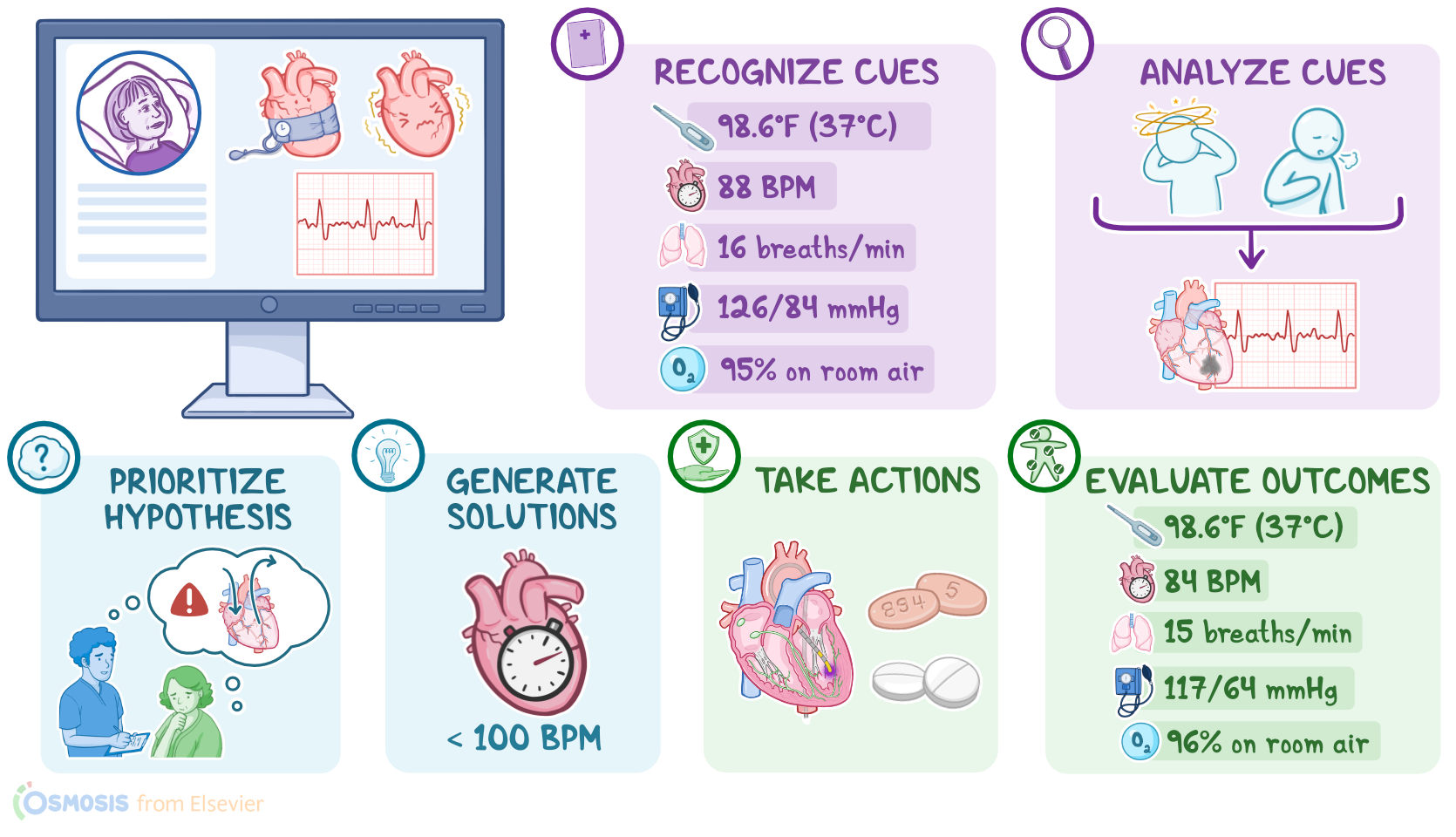
In collaboration with the registered nurse, RN Edon. Nurse Jamal goes through the steps of the clinical judgment measurement model to make clinical decisions about Lauren's care by recognizing and analyzing cues, prioritizing hypotheses, generating solutions, taking action and evaluating outcomes.
Recognizing and Analyzing Cues0:40–2:44
First, nurse Jamal recognizes important cues including Lauren's vital signs which are temperature 98.6 °F or 37 °C heart rate, 88 BPM R 16 breaths per minute BP, 126/84 millimeters of mercury and oxygen saturation of 95% on room.
Air. Laan is awake alert and appears comfortable nurse.
Jamal also notes that the bedside cardiac monitor shows that shes currently in an irregularly irregular heart rhythm. Next, nurse Jamal analyzes these cues.
He reviews the electronic health record or EHR and notes that Lauren came to the ed for dizziness and shortness of breath and was diagnosed with AFIB, which is a cardiac arrhythmia that occurs when the regular electrical impulses generated from the heart's natural pacemaker, known as the sa node are overridden by disorganized impulses from other areas of the heart.
These areas have often been damaged from the effects of conditions like hypertension or coronary artery disease. And the impulses they generate result in many rapid mini contractions, usually between 356 100 per minute.
So instead of one efficient atrial contraction, the atria have a quivering twitching movement or fibrillation. The fibrillation causes inefficient emptying from the atria into the ventricles, which means that blood tends to stay in the atria for longer than usual, increasing the risk of clot formation and embolization where a clot can be pumped from the atria to the ventricles and then into circulation.
Nural also knows the ventricles respond to the fibrillating atria at an irregular and rapid rate, typically between 101 150 BPM.
And that this rapid response of the ventricles impairs cardiac output and tissue perfusion. Nurse Jamal recognizes that Lauren needs management of her atrial fibrillation to support effective cardiac output.
Prioritizing Hypotheses, Generating Solutions, and Taking Action2:44–4:30
Now, using the information he has gathered along with Laurens medical history. Nurse gal reports, his findings to Rne Edon and together they choose a priority hypothesis of risk for impaired cardiac output.
Then they generate solutions to address Lauren's risk for impaired cardiac output and they establish the expected outcome that after intervening La's heart rate will remain below 100 BPM for the duration of the shift.
Nurse Jamal then takes action to implement these solutions. Nurse Jamal sees that Lauren is due for two oral medications, Apixaban and dilTIAZem and that she's scheduled for a cardiac ablation later today to eliminate the abnormal electrical conduction pathways in her heart causing afib nurse Jamal then gathers supplies and enters Laan room.
Hi, Lauren. I have two different medications for you.
One is Apixaban which is an anticoagulant to prevent blood clots and dilTIAZem. A channel blocker to regulate your heart rate.
Yeah. Nurse ed told me about these medications earlier.
How is my heart doing? Now?
Your heart rhythm is still irregular but the rate is controlled. Meaning that your heart is beating at less than 100 BPM.
The medication I have for you dilTIAZem will help keep it under control. Ok.
That's good to hear nural. Then gives Lauren the medications according to the principles of safe medication administration.
Do you know when Im supposed to be going for that procedure to help get my heart back to normal? Yes, it looks like you were scheduled for the ablation later this afternoon.
Ok. Good.
Prior to Lauren going for her ablation nurse, Jamal evaluates the outcomes of his actions. He takes her vital signs which are temperature 98.6 °F or 37 °C, heart rate, 84 BPM respirations, 15 breaths per minute BP, 117/64 millimeters of mercury and oxygen saturation.
Evaluating Outcomes4:30–5:01
96% on room air. The bedside cardiac monitor shows that laurens heart rhythm remains irregularly irregular.
All right, as a quick recap, nurse, Jamal recognized and analyzed cues related to lorient's atrial fibrillation and in collaboration with Rne Edon prioritized hypotheses and generated solutions to address this problem.
Review5:01–5:30
They then implemented pharmacologic and nonpharmacologic measures and evaluated laurens outcomes and compared them to the expected outcome.
Since laurens heart rate remained below 100 BPM. They determined the plan of care was successful.
| CASE STUDY – ATRIAL FIBRILLATION | ||
| KEY POINTS | MY NOTES | |
| INTRODUCTION |
| |
| RECOGNIZING AND ANALYZING CUES |
| |
| PRIORITZING HYPOTHESES, GENERATING SOLUTIONS, AND TAKING ACTION |
| |
| EVALUATING OUTCOMES |
| |
- "Adult health nursing (9th ed.)" Elsevier (2023)
- "Medical-surgical nursing (8th ed.)" Elsevier (2023)
- "Medical-surgical nursing: Concepts and practice (5th ed.)" Elsevier (2023)
No notes for this video yet
Try adding a note below