Case study - Breast cancer: Nursing
Introduction0:00–0:36
Nurse Rebecca works at an oncology clinic and is caring for Patricia, a 53-year-old female who recently had a breast biopsy confirming the diagnosis of breast cancer.
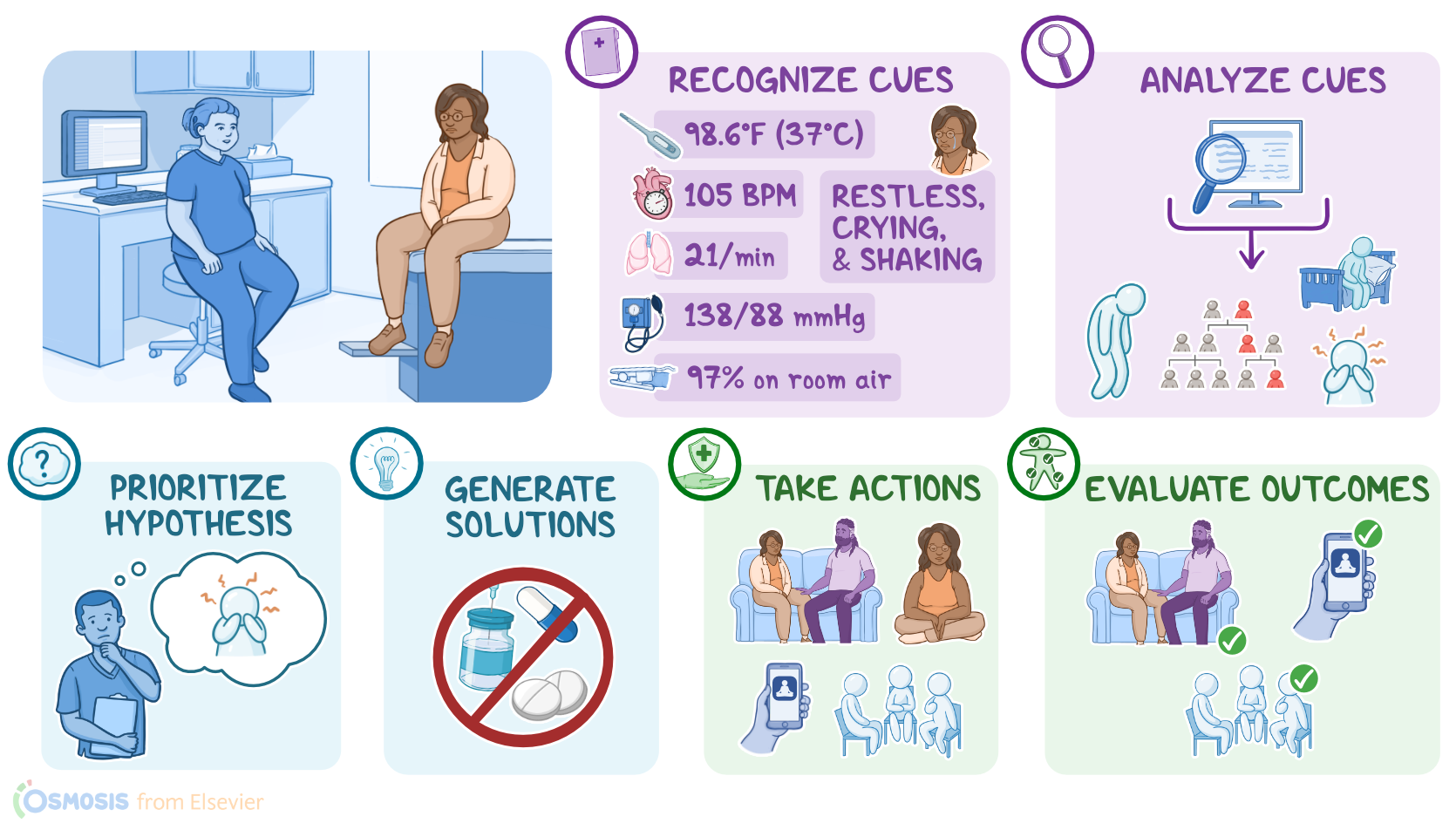
After settling Patricia in her room, Nurse Rebecca goes through the steps of the Clinical Judgment Measurement Model to make clinical decisions about Patricia’s care by recognizing and analyzing cues, prioritizing hypotheses, generating solutions, taking action, and evaluating outcomes.
First, Nurse Rebecca recognizes important cues, including Patricia’s vital signs, which include, temperature 98.6 F or 37 C, heart rate 105 beats per minute, respirations 21 breaths per minute, blood pressure 138/88 mmHg, and oxygen saturation 97% on room air.
Recognizing and Analyzing Cues0:36–1:36
Nurse Rebecca also notes that Patricia is restless, crying, and shaking and states she just doesn’t know how to handle her diagnosis.
Next, Nurse Rebecca analyzes these cues. She reviews the electronic health record, or EHR, and notes that Patricia has a family history of breast cancer.
Nurse Rebecca also sees that previous nursing assessments document Patricia’s report of fatigue and difficulty sleeping.
Nurse Rebecca recognizes that Patricia is experiencing emotional distress related to her breast cancer diagnosis. Now, using the information she's gathered, along with Patricia's medical history, Nurse Rebecca chooses a priority hypothesis of difficulty coping.
Prioritizing Hypotheses, Generating Solutions, and Taking Action1:36–3:16
Then, she generates solutions to address Patricia’s coping difficulties that will include nonpharmacologic interventions, and she establishes the expected outcome that Patricia will demonstrate effective coping skills regarding her breast cancer diagnosis by her next follow-up visit.
Nurse Rebecca then takes action to implement these solutions. After the health care provider discusses the expected treatment plan with Patricia, Nurse Rebecca follows up to see how she’s feeling about the information she’s received.
Nurse Rebecca: How are you feeling after talking with your health care provider? Patricia: Well, I’m feeling very overwhelmed and stressed.
I don’t know how I can handle this. Nurse Rebecca: It’s normal to be overwhelmed.
You received a lot of information today. In the past, what are some ways you have coped with stressful situations?
Why don’t we go through some meditative strategies before you leave the clinic and then we can call your partner? Patricia: Okay, that would really help.
Nurse Rebecca reviews some guided meditations apps that are free and available on Patricia’s smartphone. She also refers her to a local support group for patients with breast cancer.
Patricia thanks her and states that she’ll plan to use these strategies when she feels overwhelmed. Afterwards, Patricia calls her partner on the phone to discuss her diagnosis.
One week later, Patricia returns for her follow-up appointment and Nurse Rebecca evaluates the outcome of her actions. Patricia’s vital signs are temperature 97.8 F or 36.5 C, heart rate 85 beats per minute, respirations 15 breaths per minute, blood pressure 132/84 mmHg, and oxygen saturation 98 percent on room air.
Evaluating Outcomes3:16–4:00
When asked how she's feeling. Patricia says she’s feeling less overwhelmed after talking everything through with her partner.
She also reports that she’s been using the guided meditation app when she feels stressed and before bedtime, and that she’s joined the local support group.
Alright, as a quick recap…Nurse Rebecca recognized and analyzed cues related to Patricia’s difficulty coping, and prioritized hypotheses, and generated solutions to address this problem.
Review4:00–4:29
Nurse Rebecca then implemented nonpharmacologic measures to address Patricia’s concerns about her diagnosis, and evaluated Patricia’s outcomes, comparing them to the expected outcomes.
Since Patricia demonstrated effective coping skills, Nurse Rebecca determined the plan of care was successful.
| CASE STUDY - BREAST CANCER | ||
| KEY POINTS | NOTES | |
| INTRODUCTION |
| |
| RECOGNIZING AND ANALYZING CUES |
| |
| PRIORITIZING HYPOTHESES, GENERATING SOLUTIONS, AND TAKING ACTIONS |
| |
| EVALUATING OUTCOMES |
| |
- "Lewis's medical-surgical nursing: Assessment and management of clinical problems. (12th ed.)" Elsevier (2022)
- "Medical-surgical nursing: Concepts for interprofessional and collaborative care. (10th ed.)" Elsevier (2021)
No notes for this video yet
Try adding a note below