Chronic kidney disease (CKD): Nursing
Introduction0:00–0:22
Chronic kidney disease, or CKD for short, is a condition characterized by a slow and progressive decrease in kidney function, with a glomerular filtration rate, or GFR, of less than 60 mL/minute that develops over a minimum of three months.Now, let’s take a closer look at how the kidneys work.
Physiology0:22–2:03
In addition, they secrete important hormones, and are essential in regulating the acid-base balance, pH, blood pressure, and electrolyte levels in the body.
Within each kidney, there are millions of tiny functional units called nephrons, which consist of a renal corpuscle and a set of renal tubules.
The renal corpuscle is where blood filtration occurs, and it includes the glomerulus, a tiny bundle of capillaries, and the Bowman’s capsule, a cup-shaped structure that surrounds the glomerulus.
As blood flows through the glomerulus, water and small solutes dissolved in the blood are filtered into the Bowman’s capsule, creating an ultrafiltrate of blood.
This filtrate then travels through the renal tubules, where urine is ultimately produced and modified according to the body’s necessities.
The rate at which renal filtration takes place is called glomerular filtration rate, or GFR for short, and it is one of the main measures of kidney function.
In a healthy adult, the estimated GFR is around 100-120 mL/min, and this value decreases slowly in all of us as we grow older.All right, now, several conditions can speed up the rate at which GFR deteriorates, increasing the risk of developing CKD.
Causes & risk factors2:03–3:22
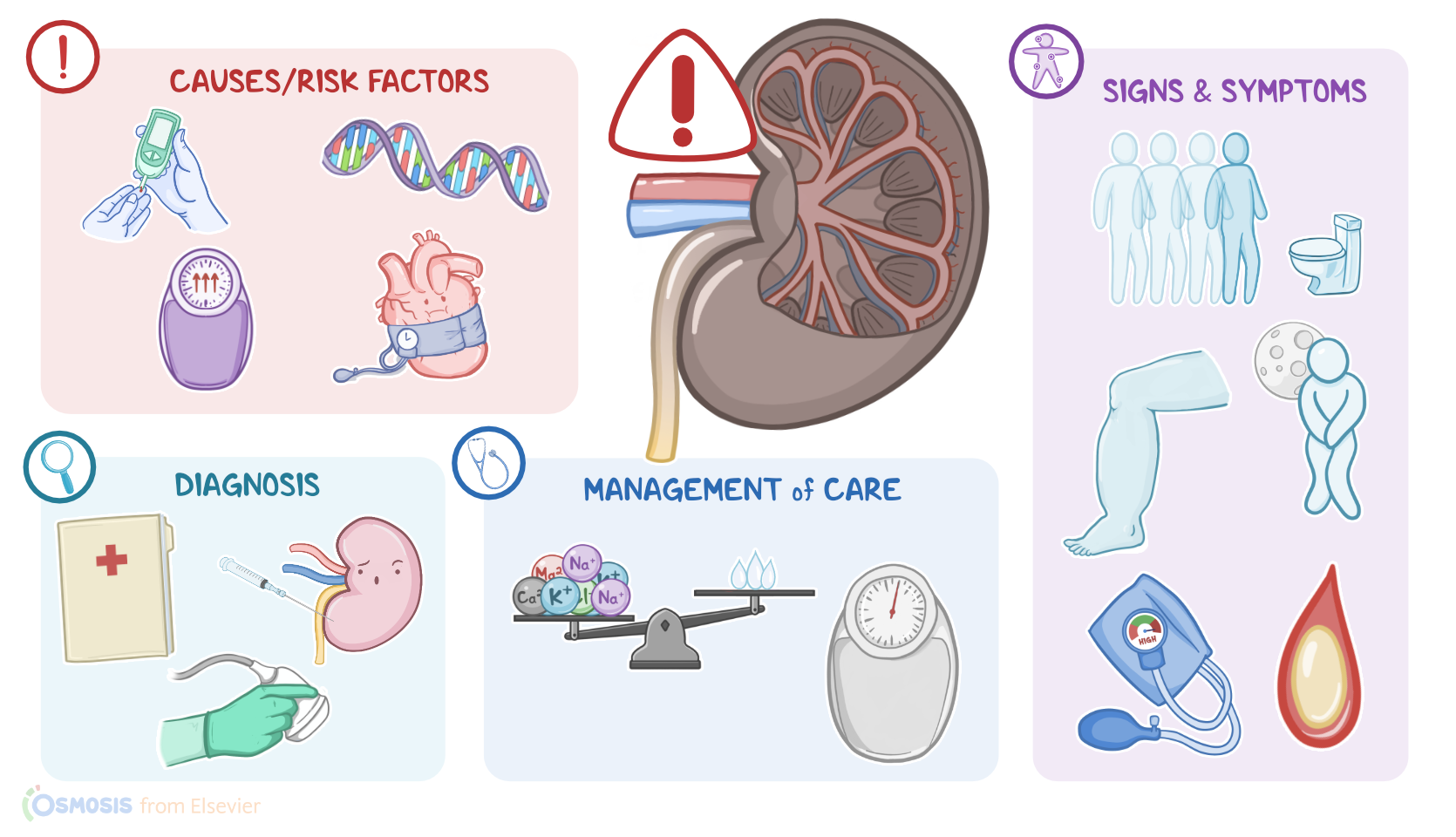
In the United States, the leading causes of CKD are diabetes mellitus and hypertension, both of which are more common in elderly clients.
Less common causes include renal artery stenosis, glomerular diseases, polycystic renal disease, tubulointerstitial diseases, and systemic disorders, like lupus or amyloidosis.
Additionally, repeated episodes of pyelonephritis or obstructive uropathy, such as prostate disease, can also lead to CKD.
Regarding risk factors for CKD, modifiable ones include obesity, cardiovascular disease, uncontrolled diabetes mellitus, smoking, and exposure to nephrotoxic medications like NSAIDs or aminoglycosides; while nonmodifiable risk factors include being over 60 years of age and having a genetic predisposition to kidney disease.Now, regardless of its cause, CKD results from progressive and irreversible damage to the kidneys, leading to a gradual decline in kidney function.
Pathology3:22–4:41
As a result, the kidneys gradually lose their ability to concentrate the urine and excrete wasteful substances or toxins.
So, CKD can be classified into five stages by determining the estimated GFR, which is measured in units of milliliters per minute per 1.73 square meters.
In clients at stage 1 CKD, there’s still a normal kidney function, since the remaining healthy nephrons are able to adapt, become larger, and work harder to maintain urine production.
As the disease progresses into stage 2 CKD, kidney function is mildly decreased; while in stage 3 CKD, there’s a moderate decrease, and in stage 4 CKD, there’s a severe decrease in kidney function.
Over time, as CKD progresses into stage 5, kidney function is completely lost, and clients develop renal failure, also known as end-stage kidney disease, or ESRD for short.
Now, the body is capable of coping with a significant reduction in kidney function without causing any symptoms, which makes CKD a largely silent disease.
Clinical manifestations4:41–6:51
In addition, as urine output decreases, wasteful substances or toxins like urea and creatinine begin to accumulate in the body; this can lead to uremia, which may cause general symptoms like fatigue, nausea, and loss of appetite.
As toxin levels build up, they can affect the functioning of the nervous system, resulting in uremic encephalopathy. This can cause asterixis, a tremor of the hand that appears when a client attempts to extend their wrists, along with ataxia and lethargy.
The buildup of toxins can also affect the heart causing pericarditis. In some cases, clients can develop uremic frost, where urea crystals deposit in the skin giving the appearance of powdery snowflakes.
Additionally, clients with CKD often have hypertension due to sodium retention and activation of the renin-angiotensin system.
Finally, clients may develop blood abnormalities, such as anemia, hyperkalemia, metabolic acidosis, and disorders of phosphate and calcium metabolism.
Over time, resorption of calcium from the bones in an attempt to restore blood calcium levels can leave bones weak and brittle, which is known as renal osteodystrophy.Ultimately, diagnosis of CKD is based on laboratory tests.
These include blood tests showing an increase in blood creatinine, BUN, as well as a decrease in an estimated GFR. A urinalysis will show proteinuria, hematuria, white blood cells, glucose, and casts.
Diagnosis6:51–7:51
If the exact cause of CKD is unknown, an abdominal ultrasound can be done to look for signs of scarring or polycystic kidneys, as well as obstructive uropathy.
In long-term ESRD, X-rays may be done to check for renal osteodystrophy. Finally, a kidney biopsy can be done to look for inflammation, scarring or unusual deposits of a protein, and to determine how far CKD has advanced.The goal of the treatment in CKD depends on the stage.
In clients at stages 1 and 2, the main goal is making sure the client has an adequate fluid balance, as well as slowing down the decline in kidney function and preventing complications.
Treatment7:51–9:50
This involves lifestyle modifications like smoking cessation, stopping any nephrotoxic medications, and maintaining a tight blood glucose control among clients with diabetes mellitus.
Two of the main factors involved in the progression of CKD are hypertension and proteinuria, so clients often require treatment with an ACE inhibitor like enalapril or an ARB like losartan.
Clients with hyperlipidemia should be started on lipid lowering agents to reduce cardiovascular risk.On the other hand, in clients with stage 3 CKD, all blood abnormalities like anemia and electrolyte imbalances should be corrected as needed.
If there’s evidence of renal osteodystrophy, additional measures, like calcium supplementation or treatment with phosphate binders, should be taken to prevent further loss of bone density.
When clients reach stage 4, kidney function is severely reduced, so treatment involves getting them prepared for renal replacement therapy options, which include hemodialysis, peritoneal dialysis, and renal transplantation.
Finally, in stage 5 CKD, the remaining kidney function is not enough to maintain life, so clients should be started on renal replacement therapy and consider kidney transplantation.Now, let’s look at the nursing care of a client with chronic kidney disease.
Keep in mind that nursing care may vary based on the progression and stage of kidney dysfunction that your client is experiencing.
Management and care9:50–14:59
The overall goals are to maintain fluid and electrolyte balance, slow the progression of the disease, and manage any disease complications.
Begin assessing your client’s kidney function by reviewing their most recent laboratory test results, including BUN, creatinine, urinalysis, and estimated GFR.
Then, assess their current fluid status by monitoring their vital signs, heart and lung sounds, fluid intake and output, as well as urine frequency, color and characteristics.
Be sure to report signs of fluid overload, such as a rapid or bounding pulse, hypertension, and extra heart sounds, or signs of pulmonary edema like shortness of breath, lung crackles, restlessness, anxiety, or frothy, blood-tinged sputum.
Then, place your client in a high-Fowler position, and administer oxygen if indicated. Also, be sure to monitor your client’s weight at the same time each day, on the same scale, and with the same amount of clothing; and report any significant changes in weight, such as a 2 Kg or 4.4 pound weight gain in one day.
Administer the prescribed medications and implement a fluid restriction, including oral, enteral, and intravenous fluids for clients with fluid retention.
Now, your client with CKD may also experience electrolyte imbalances, so review their laboratory test results including sodium, potassium, calcium, magnesium, and phosphorus.
If any imbalances occur, be prepared to correct them by administering the prescribed medications. If your client experiences any indications of hyperkalemia, like an irregular heartbeat, chest pain, weakness, fatigue, or muscle cramps, report these findings and be prepared to administer potassium-lowering medications, like oral sodium polystyrene sulfonate, intravenous insulin, or intravenous calcium gluconate.
Now, your client undergoing renal replacement therapy may have a long-term vascular access device, which can include an internal arteriovenous or AV fistula, or an arteriovenous or AV graft.
First, assess the insertion site for any signs of infection, including redness, swelling, or pain, and report these findings immediately.
Then, assess for adequate circulation by checking distal pulses and capillary refill of the affected arm, as well as palpating the site for the presence of a thrill and auscultating over the site for a bruit.
Report any signs of inadequate circulation, including temperature or color changes to the fingers or a decreased pulse rate; as well as any signs of clotting, which can include a client report of tingling or discomfort in the affected arm, as well as the inability to palpate a thrill or auscultate a bruit.
Also, be sure that all staff members caring for the client know to avoid checking blood pressures or performing venipuncture sticks in the affected arm.
On the other hand, your client may have a short-term access device for renal replacement therapy, which can include a dialysis catheter inserted into the subclavian, internal jugular, or femoral vein.
Be sure to regularly assess the insertion site for the presence of hematomas, bleeding, catheter dislodgement, and signs of an infection, which can include redness, swelling, and purulent discharge, and report your findings immediately to the healthcare provider.
Finally, assess your client’s psychosocial needs, such as anxiety, depression, and changes in self-perception as they adjust to their diagnosis.
Ask them about their expectations for treatment, and encourage them to discuss their concerns. Assist your client to develop coping skills, and provide referrals to local support groups and the clinic social worker, as needed.Now, moving on to client education.
Explain to your client that the best ways to reduce the risk of further injury to the kidneys include following their treatment plan, optimizing their blood pressure, and having tight blood glucose control.
General client and family teaching14:59–17:00
Let your client know they should talk to their healthcare provider before starting any new medications, and they should avoid nephrotoxic medications like certain antibiotics and NSAIDs; as well as avoid exposure to radiographic contrast dye, pesticides, and heavy metals like arsenic.
Also, remind your client that they will need to follow up regularly with their healthcare provider to monitor their CKD.
Then, teach your client the recommended lifestyle modifications. Encourage your client to maintain good nutrition while following a renal diet that consists of a moderate protein intake, as well as low sodium, potassium, and phosphorus.
Advise your client that they should restrict their fluids, and plan to spread out all daily intake of fluids over a 24-hour period of time.
Provide them with a list of foods to include in their diet and foods to avoid, and refer them to the renal dietician for additional support.
Also, teach your client to safely self-administer any prescribed medications. Lastly, advise your client to weigh themselves daily at the same time, and in the same type of clothing; and report any weight gain greater than 2 Kg or 4.4 pounds, as well as any increases in blood pressure, shortness of breath, swelling in the extremities, or changes to their urine appearance, frequency, or volume.
All right, as a quick recap… Chronic kidney disease is a progressive, irreversible loss of kidney function with a decreased glomerular filtration rate, or GFR.
Review17:00–18:29
Over time, as urine output decreases, wasteful substances or toxins like urea and creatinine begin to accumulate in the body; this can lead to uremia, which may cause general symptoms like fatigue, nausea, and loss of appetite, and adversely affects multiple body systems, including neurological, metabolic, cardiovascular, pulmonary, hematologic, and integumentary systems.
Nursing goals are to maintain fluid and electrolyte balance, slow the progression of the disease, and manage any disease complications.
Client and family education includes lifestyle modifications, safe medication self-administration, and when to contact the healthcare provider.
metabolic cardiovascular, hematologic, and integumentary systems. Nursing goals are to maintain fluid and electrolyte balance.
Will the progression of the disease and manage any disease complications? Client and family.
Education includes the lifestyle modifications, safe medication, self-administration. And when to contact the healthcare provider,
| CHRONIC KIDNEY DISEASE (CKD) | ||
| KEY POINTS | NOTES | |
| DEFINITION |
| |
| PHYSIOLOGY |
| |
| CAUSES AND RISK FACTORS |
| |
| PATHOPHYSIOLOGY |
| |
| SIGNS AND SYMPTOMS |
| |
| DIAGNOSIS |
| |
| TREATMENT |
| |
| MANAGEMENT OF CARE |
| |
| PATIENT AND FAMILY TEACHING |
| |
No notes for this video yet
Try adding a note below