Complete metabolic panel (CMP) - Calcium: Nursing
The nurse is caring for a 65-year-old client after a total thyroidectomy on the medical-surgical unit. While taking his blood pressure, the nurse notices involuntary contraction of the muscles in the hand and wrist. Based on these findings, a basic metabolic panel, or BMP is ordered to check the client’s electrolytes, including their calcium level.
Calcium is a positively charged ion noted as Ca2+. About 99% of that calcium is in our bones in the form of calcium phosphate. The last 1% is split so that the majority, about 0.99% is extracellular, which means in the plasma and in the interstitial space between cells; and 0.01% is intracellular or inside cells. Most of the calcium in the plasma circulates in two forms; in a free, ionized form, or in a form bound to proteins, like albumin.
The total of these two forms of calcium can be measured on its own or as part of a complete metabolic panel, or CMP, which is also called a basic metabolic panel, or BMP; and in adults, it normally ranges from 9 to 10.5 mg/dL. Calcium is essential for strong bones and teeth, muscle contraction, cell membrane stability, and blood coagulation. It also helps with regulating a normal heart rhythm, releasing neurotransmitters from neurons, as well as releasing hormones from the endocrine glands.
Calcium comes from a variety of sources including dairy products like milk, cheese, and yogurt; as well as leafy green vegetables, and canned fish like salmon and sardines. Once ingested, calcium is absorbed into the bloodstream. Most of it goes to the bone, and the rest of calcium circulates in the bloodstream, while some of it is excreted by the kidneys and in the stool.
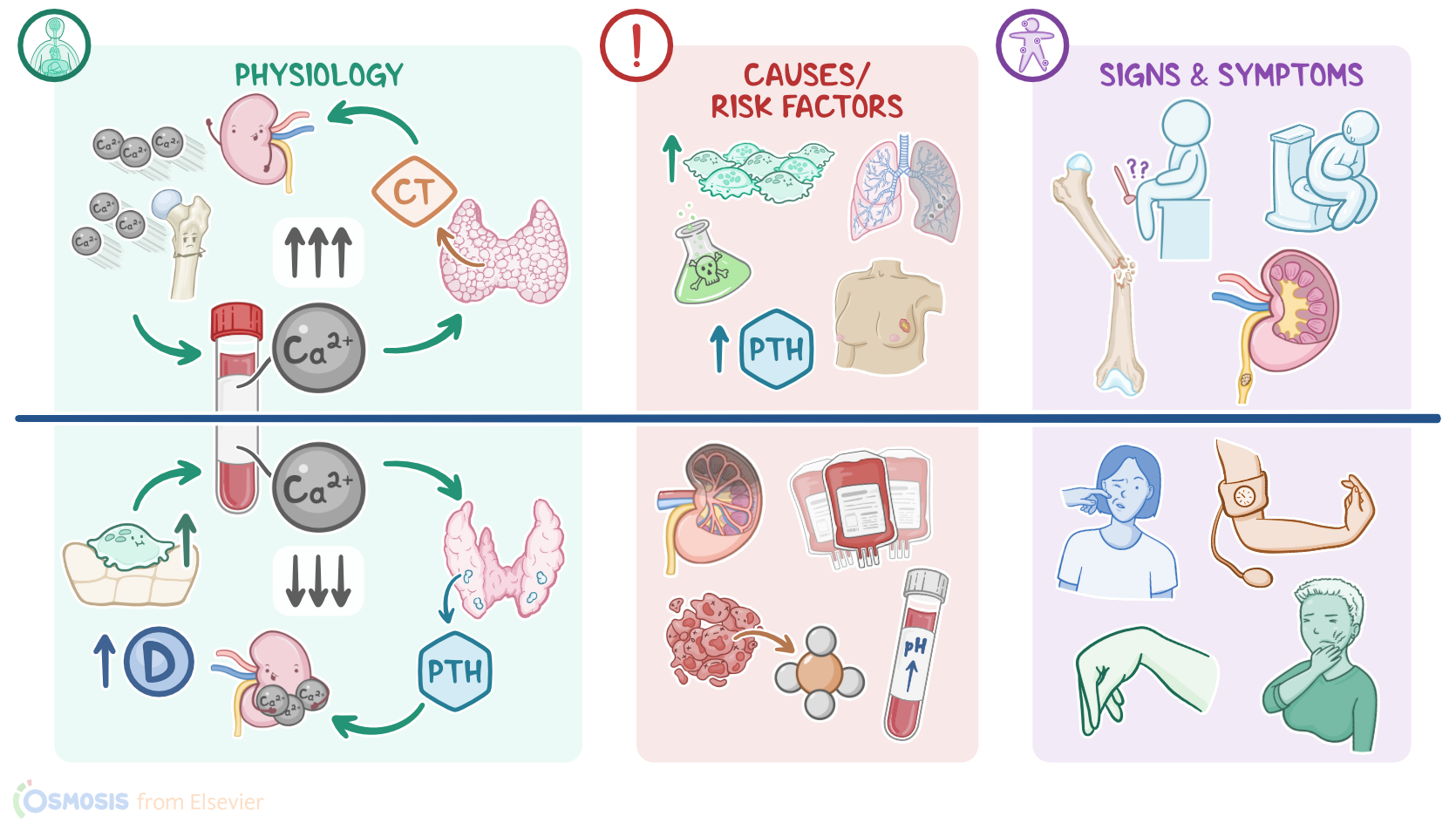
Now, calcium homeostasis is regulated by three molecules, parathyroid hormone, or PTH, a hormone made by the parathyroid glands located in the neck on top of the thyroid gland; calcitonin, which is produced by the parafollicular cells of the thyroid gland; and vitamin D, a fat-soluble vitamin synthesized in the skin through sunlight exposure and then activated in the liver and kidneys.
Okay, now when plasma calcium level decreases, that stimulates PTH secretion. In the bone, PTH activates osteoclasts, which are little bone eating cells, and as a result, calcium is released into the bloodstream. PTH also stimulates vitamin D synthesis in the kidneys, which promotes calcium absorption in the gut, thereby increasing the plasma calcium level. Finally, PTH increases calcium reabsorption by the kidneys.
Now, calcitonin does the exact opposite of PTH, so if plasma calcium is too high, calcitonin inhibits calcium reabsorption in the bones, decreases calcium absorption in the gut, and increases calcium excretion from the kidneys.
Alright, now there are certain conditions that can cause hypercalcemia, or an increased plasma calcium level. One cause of hypercalcemia is when too much calcium enters the blood. This can be caused by hyperparathyroidism, which results in high levels of PTH that increase bone resorption by the osteoclasts.
Hypercalcemia can also be caused by malignancies including breast, lung, and prostate cancer. This is because when there’s metastatic bone disease, the bone tissue is destroyed and calcium is released into the plasma. Malignancies can also lead to hypercalcemia by producing a PTH-related peptide that acts like PTH. Excess vitamin D, either through the diet or through supplements, can cause too much calcium absorption in the gut; while prolonged immobilization, causes more calcium to be released from the bones and into circulation. Hypercalcemia can also be the result of too much calcium leaving the blood, like with renal failure. Finally, acidosis can promote hypercalcemia because it causes less calcium to bind with albumin, so there’s more calcium circulating in the plasma.
Now, clinical manifestations of hypercalcemia are mostly due to decreased excitability of cell membranes. So, there can be neuromuscular symptoms like muscle weakness and hyporeflexia; alterations in cardiac conduction, which can cause arrhythmias; and gastrointestinal manifestations like constipation and nausea. There’s also a high risk for developing bone fractures as the bones become more fragile; and kidney stones as the kidneys work hard to remove the excess calcium. Finally, hypercalcemia can affect the central nervous system, causing confusion and stupor.
Okay, now there are certain conditions that can cause hypocalcemia, or a decreased plasma calcium level. One cause of hypocalcemia is when not enough calcium enters the blood. This can be caused by hypoparathyroidism, resulting in too little PTH, and decreased bone resorption by the osteoclasts. This can be caused by the destruction of the parathyroid gland, either during surgery on the thyroid, or due to autoimmune destruction. Hypocalcemia can also be caused by malnutrition, and a decreased intake of calcium and vitamin D.
Then there’s tissue injury, like with burns, rhabdomyolysis, and tumor lysis syndrome, where large numbers of cells die, and release intracellular phosphate into the blood. The phosphate binds to the free calcium in the blood and forms the insoluble compound calcium phosphate, which effectively decreases the total amount of calcium in blood. The calcium level can also fall as a result of having too many blood transfusions because additives in the blood like citrate and ethylenediaminetetraacetic acid or EDTA, can chelate or bind to calcium, forming complexed calcium, which is an inactive molecule. Hypocalcemia can also be the result of too much calcium leaving the blood. This might happen in kidney failure, when excess calcium is excreted into the urine. Finally, alkalosis can promote hypocalcemia because it causes more calcium to bind with albumin, so there’s less calcium available in the plasma.
Alright, clinical manifestations of hypocalcemia are mostly due to increased excitability of cell membranes. So, there may be neuromuscular symptoms like tetany, which are intermittent muscular spasms; as well as perioral tingling, or paresthesia of the toes or fingers. Cardiac manifestations can include alterations in cardiac conduction, which can cause arrhythmias. On clinical examination, there may be a positive Chvostek sign. That’s when the facial muscles contract in response to tapping the skin over the facial nerve, just 2 centimeters anterior to the ear. Another sign is the Trousseau sign. That’s where a blood pressure cuff is placed over the individual’s arm and is inflated to a pressure above the systolic blood pressure and is held like that for 3 minutes. A positive Trousseau sign is when there’s a muscle spasm in the arm and forearm.
| CALCIUM | ||
| KEY POINTS | NOTES | |
| PHYSIOLOGY |
| |
| PATHOLOGY |
| |
| INDICATIONS |
| |
| NURSING IMPLICATIONS |
| |
No notes for this video yet
Try adding a note below