Myocardial infarction (MI): Nursing process (ADPIE)

2,319views

Myocardial infarction (MI): Nursing process (ADPIE)

Acute Final

Acute Final

Endocrine system anatomy and physiology
Antepartum assessment - Fetus: Nursing
Assessment of gestational age: Nursing
Fetal circulation: Nursing
Fetal development: Nursing
Group B streptococcus (GBS) infection in pregnancy: Nursing
Hepatitis B virus (HBV) infection in pregnancy: Nursing
Hyperemesis gravidarum: Nursing
Large for gestational age (LGA) infant: Nursing
Preeclampsia and eclampsia: Nursing
Prenatal screening: Nursing
Placenta previa: Nursing process (ADPIE)
Placental abruption: Nursing process (ADPIE)
Birth-related procedures: Nursing
Cesarean birth: Nursing
Intrapartum assessment - Fetal heart rate patterns: Nursing
Intrapartum assessment - Uterine activity: Nursing
Premature rupture of membranes (PROM): Nursing
Shoulder dystocia: Nursing
Prolapsed umbilical cord: Nursing process (ADPIE)
Stages of labor: Nursing
Assessment - Postpartum: Nursing
Perinatal depression: Nursing
Physiology of lactation: Nursing
Postpartum infections: Nursing
Postpartum hemorrhage: Nursing
Biliary atresia: Nursing
Cleft lip and palate: Nursing
Congenital diaphragmatic hernia: Nursing
Congenital heart defects - Acyanotic: Nursing
Congenital heart defects - Cyanotic: Nursing
Esophageal atresia and tracheoesophageal fistula: Nursing
Craniosynostosis: Nursing
Hemolytic disease of the fetus and newborn: Nursing
Hyperbilirubinemia: Nursing process (ADPIE)
Infant of a diabetic mother (IDM): Nursing
Meconium aspiration syndrome: Nursing
Neonatal respiratory distress syndrome (NRDS): Nursing
Neonatal sepsis: Nursing
Neural tube defects: Nursing
Newborn adaptation to extrauterine life: Nursing
Persistent pulmonary hypertension of the newborn (PPHN): Nursing
Physical assessment - Neonate: Nursing
Small for gestational age (SGA) infant: Nursing
Postterm infant: Nursing
Thermoregulation - Neonate: Nursing
Arterial blood gas (ABG) - Overview: Nursing
Arterial blood gas (ABG) - Metabolic acidosis: Nursing
Arterial blood gas (ABG) - Metabolic alkalosis: Nursing
Arterial blood gas (ABG) - Respiratory acidosis: Nursing
Arterial blood gas (ABG) - Respiratory alkalosis: Nursing
Adrenal insufficiency (Addison disease): Nursing
Anemia - Iron-deficiency: Nursing
Anemia - Aplastic: Nursing
Anemia - Macrocytic: Nursing
Case study - Hypothyroidism: Nursing
Case study - Iron-deficiency anemia: Nursing
Case study - Sickle cell anemia: Nursing
Complete blood count (CBC) - Hemoglobin and hematocrit: Nursing
Complete blood count (CBC) - Red blood cells (RBC): Nursing
Complete blood count (CBC) - Platelets: Nursing
Complete metabolic panel (CMP) - Blood urea nitrogen (BUN) and creatinine (Cr): Nursing
Complete metabolic panel (CMP) - Estimated glomerular filtration rate (eGFR): Nursing
Complete metabolic panel (CMP) - Liver function tests (LFT): Nursing
Cushing syndrome and Cushing disease: Nursing
Hematopoietic growth factors: Nursing pharmacology
Hyperparathyroidism: Nursing
Hyperthyroidism: Nursing process (ADPIE)
Hypoparathyroidism: Nursing
Hyperpituitarism: Nursing
Hypopituitarism: Nursing
Hypothyroidism: Nursing process (ADPIE)
Medications affecting the parathyroid glands: Nursing pharmacology
Medications for growth hormone disorders: Nursing pharmacology
Medications for thyroid disorders: Nursing pharmacology
Neutropenia: Nursing
Polycythemia: Nursing
Thrombocytopenia: Nursing
Acute kidney injury (AKI): Nursing process (ADPIE)
Benign prostatic hyperplasia (BPH): Nursing process (ADPIE)
Case study - Cholecystitis: Nursing
Case study - Cirrhosis: Nursing
Case study - Chronic kidney disease (CKD): Nursing
Case study - Benign prostatic hyperplasia (BPH): Nursing
Case study - Gastroesophageal reflux disease (GERD): Nursing
Case study - Pediatric appendicitis: Nursing
Case study - Pyelonephritis: Nursing
Cholecystitis: Nursing
Cholelithiasis: Nursing
Chronic kidney disease (CKD): Nursing
Cirrhosis: Nursing process (ADPIE)
Diverticular disease: Nursing
Gastroesophageal reflux disease (GERD): Nursing process (ADPIE)
Hemolytic uremic syndrome: Nursing
Hirschsprung disease: Nursing
Intestinal obstruction: Nursing
Irritable bowel syndrome (IBS): Nursing
Nephrotic syndrome: Nursing
Pyloric stenosis: Nursing process (ADPIE)
Renal and urinary calculi: Nursing
Urinary incontinence - Stress: Nursing process (ADPIE)
Diabetes insipidus: Nursing process (ADPIE)
Dialysis care: Nursing
Case study - Diabetic ketoacidosis (DKA): Nursing
Case study - Pediatric diabetes mellitus type 1: Nursing
Diabetes mellitus (DM): Nursing process (ADPIE)
Hyperosmolar hyperglycemic state (HHS): Nursing process (ADPIE)
Diabetic ketoacidosis (DKA): Nursing process (ADPIE)
Case study - Epilepsy: Nursing
Case study - Head injury: Nursing
Epidural and subdural hematoma: Nursing
Case study - Stroke: Nursing
Hemorrhagic stroke - Intracranial hemorrhage (ICH) and subarachnoid hemorrhage (SAH): Nursing
Increased intracranial pressure (ICP): Nursing
Hydrocephalus: Nursing process (ADPIE)
Intracranial aneurysm: Nursing
Seizure disorder: Nursing process (ADPIE)
Stroke: Nursing process (ADPIE)
Jaundice: Nursing
Nutrition - Enteral: Nursing skills
Nutrition - Newborn: Nursing
Nutrition - Parenteral: Nursing skills
Phenylketonuria (PKU): Nursing
Arterial embolism: Nursing
Disseminated intravascular coagulation (DIC): Nursing
Hemophilia: Nursing process (ADPIE)
Acute respiratory distress syndrome (ARDS): Nursing
Asthma: Nursing process (ADPIE)
Atelectasis: Nursing
Bacterial pneumonia: Nursing process (ADPIE)
Bronchiolitis and respiratory syncytial virus (RSV): Nursing process (ADPIE)
Case study - Acute respiratory distress syndrome (ARDS): Nursing
Care of an intubated client: Nursing skills
Case study - Chronic obstructive pulmonary disease (COPD): Nursing
Case study - Impaired gas exchange: Nursing
Case study - Pediatric asthma: Nursing
Chest tube care: Nursing
Chronic obstructive pulmonary disease (COPD): Nursing process (ADPIE)
Cystic fibrosis: Nursing
Epiglottitis: Nursing process (ADPIE)
Flail chest: Nursing
Intraoperative care: Nursing
Pleural effusion: Nursing
Pneumothorax and hemothorax: Nursing
Pulmonary edema: Nursing
Smoke inhalation injury: Nursing process (ADPIE)
Tracheostomy: Nursing
Venous thromboembolism (VTE): Nursing process (ADPIE)
Arrhythmias - Asystole: Nursing
Arrhythmias - Atrial flutter (Aflutter): Nursing
Arrhythmias - Premature atrial contractions (PACs): Nursing
Arrhythmias - Heart blocks: Nursing
Arrhythmias - Atrial fibrillation (Afib): Nursing
Arrhythmias - Premature ventricular contractions (PVCs): Nursing
Arrhythmias - Sinus tachycardia and sinus bradycardia: Nursing
Arrhythmias - Supraventricular tachycardia (SVT): Nursing
Arrhythmias - Ventricular fibrillation (Vfib): Nursing
Arrhythmias - Ventricular tachycardia (Vtach): Nursing
Cardiac biomarkers - Troponin: Nursing
Case study - Acute coronary syndrome (ACS): Nursing
Case study - Atrial fibrillation (Afib): Nursing
Case study - Heart failure with reduced ejection fraction (HFrEF): Nursing
Case study - Deep vein thrombosis (DVT): Nursing
Case study - Hypertension: Nursing
Case study - Hypovolemic shock: Nursing
Coronary artery disease (CAD) and angina pectoris: Nursing process (ADPIE)
Electrocardiogram (ECG) - Normal sinus rhythm (NSR): Nursing
Heart defects that decrease pulmonary blood flow - Nursing considerations & client education: Nursing
Hypertension: Nursing process (ADPIE)
Left-sided heart failure: Nursing process (ADPIE)
Myocardial infarction (MI): Nursing process (ADPIE)
Pericardial effusion and cardiac tamponade: Nursing process (ADPIE)
Peripheral arterial disease (PAD): Nursing process (ADPIE)
Rheumatic heart disease: Nursing process (ADPIE)
Shock - Cardiogenic: Nursing
Shock - Neurogenic: Nursing
Shock - Obstructive: Nursing
Shock - Septic: Nursing
Sickle cell disease: Nursing process (ADPIE)
Valvular heart disease: Nursing

Notes

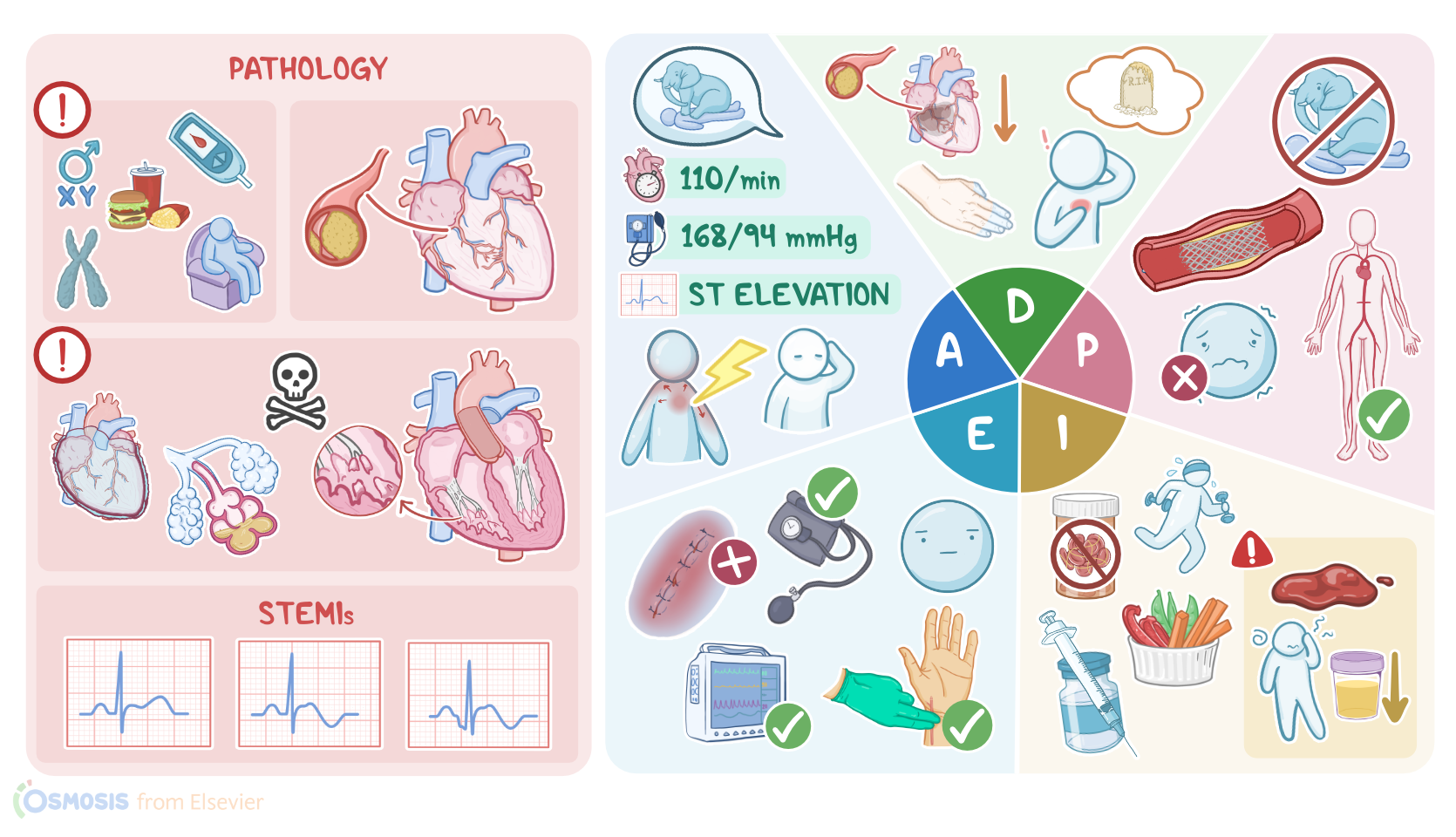
MYOCARDIAL INFARCTION (MI)

KEY POINTS
NOTES
PATIENT REPORT
  • 60-year-old man
  • History hypertension
  • Chest pain
  • Feelings like elephant sitting on chest
  • ECG: ST segment elevation MI (STEMI)
  • Percutaneous coronary intervention (PCI)

PATHOPHYSIOLOGY
  • MI
    • Death of cardiac muscle tissue from prolonged ischemia
    • Risk factors
      • Over 40 years of age
      • Assigned male at birth
      • Diabetes mellitus
      • Dyslipidemia
      • Hypertension
      • Family history of MI
      • Smoking
      • Obesity
      • Sedentary
      • High fat diet
    • Causes
      • Atherosclerosis
        • Plaque builds up in coronary arteries
        • Blood supply cannot meet demands of myocardium
        • Ischemia occurs
  • Angina
    • Chest pain
    • Stable
      • Provoked by activities
      • Lasts 15 minutes or less
      • Relieved with rest or vasodilators
    • Unstable
      • Occurs without exertion
      • Lasts longer than 15 minutes
      • More severe
      • Not relieved with rest or vasodilators
  • Treatment
    • Oxygen
    • Vasodilators
    • Analgesics
    • PCI
    • Thrombolytic therapy
    • Coronary artery bypass graft (CABG)
    • Lifestyle modifications

ASSESSMENT
  • Pale, diaphoretic, anxious
  • Pain: 10/10, radiating down arm
  • Blood pressure: 168/94 mmHg
  • Heart rate: 110
  • S4 heart sound
  • ECG: ST segment elevation
  • Lung sounds clear
  • Respiratory rate: 20
  • Oxygen saturation: 94% on 4L
  • Bowel sounds active
  • Nauseated
  • Extremities cool with delayed capillary refill
  • Temperature: 99.2 F (37.2 C)
  • Troponin I, troponin T, and CK-MB increased
  • Platelets: 254,000/mm3 (254 x 109/L)
  • Hemoglobin: 16 g/dL (160 g/L)
  • Leukocytes: 13,000/mm(13 x 109/L)
  • Potassium: 3.5 mEq/L (3.5 mmol/L)
  • Creatinine: 1.0 mg/dL (88.4 μmol/L)

NURSING DIAGNOSES
  • Decreased cardiac output related to coronary artery occlusion
  • Ineffective cardiac and peripheral tissues perfusion related to reduced coronary blood flow
  • Acute pain related to myocardial ischemia
  • Anxiety related to new situational crisis
  • Deficient knowledge related to post-MI and PCI care

PLANNING
  • Cardiac output will maintain perfusion
  • No chest pain
  • Anxiety will decrease
  • Verbalize understanding of post-MI and PCI care

IMPLEMENTATION
  • Delegate vital signs
  • Administer IV morphine
  • Transport to catheterization lab and give report
  • Post-PCI
    • Monitor vital signs and ECG 
    • Monitor heart and lung sounds
    • Monitor pain
    • Monitor level of consciousness
    • Monitor anxiety
    • Monitor urine output
    • Monitor extremities 
    • Monitor peripheral pulses
    • Monitor insertion site
    • Administer medications as ordered prescribed
    • Teach about medications
    • Repositioned every 2 hours
    • Physical therapy consulted
    • Cardiac rehabilitations referral placed
    • Teach about post-MI and PCI care
    • Review lifestyle modifications

EVALUATION
  • Temperature: 98.9 F (37.1 C)
  • Heart rate: 75
  • Respiratory rate: 14
  • Lung sounds clear
  • Blood pressure: 128/70 mmHg
  • Oxygen saturation: 98% room air
  • Chest pain: 0/10
  • Insertion site pain: 2/10
  • ECG: normal sinus rhythm 
  • Skin warm and dry with brisk capillary refill 
  • Voiding pale yellow urine
  • Denies numbness to extremities
  • Peripheral pulses equal
  • Insertion site shows no bleeding, hematoma, or infection
  • Alert, oriented, less anxious
  • Troponin I, troponin T, and CK-MB peaked

Transcript

Watch video only

Miguel Garcia is a 60-year-old Hispanic male with a history of hypertension who was brought to the emergency department, or ED, for chest pain.

The pain began two hours ago and he states it feels like an elephant is sitting on his chest.

The physician just confirmed with an electrocardiogram, or ECG, that Mr. Garcia is experiencing a STEMI, which stands for ST segment elevation myocardial infarction.

The team is acting swiftly to prepare him for an emergent percutaneous coronary intervention, known as a PCI.

A myocardial infarction, also known as an MI or heart attack, refers to the death of cardiac muscle tissue from prolonged ischemia.

Risk factors include being over 40 years old or male; having diabetes mellitus, dyslipidemia, hypertension, or a family history of MIs; smoking tobacco; obesity; a sedentary lifestyle; and eating a high fat diet.

The most common cause of MI is atherosclerosis. This is when lipid containing plaque builds up in the coronary arteries.

When the coronary artery is occluded, blood and oxygen supply cannot meet the demands of the myocardium, causing ischemia.

This leads to angina, or a type of chest pain. Angina can either be stable or unstable.

Stable angina is provoked by activities that increase oxygen demand, such as exercise, lasts up to 15 minutes, and is relieved by rest or vasodilators like nitroglycerin.

This is because the occlusion limits blood flow while the oxygen demand of the myocardium increases, but when demand decreases or if the artery becomes dilated, the pain resolves

On the other hand, unstable angina can occur without exertion or even at rest, persists longer than 15 minutes, is a more severe pain than stable angina, and is not relieved by rest or vasodilators.

This is often due to the plaque rupturing which causes platelets to attach to the plaque, forming a thrombus.

The result is a more severe reduction in coronary blood flow than what occurs in stable angina, so it doesn’t resolve with rest or vasodilators.

Initially, ischemic damage is potentially reversible, but after about 20 to 40 minutes the damage is irreversible and myocardial tissue starts to necrose, causing an MI.

During an MI, the lack of blood supply to the myocardium can cause severe crushing substernal chest pain.

The pain is unprovoked, which means it occurs spontaneously regardless of activity, persists over thirty minutes, is unrelieved by rest or vasodilators like nitroglycerin, and can radiate to the shoulders, arms, jaw, neck, or back.

The myocardial oxygen supply and demand imbalance during an MI can also lead to blood pressure and heart rate changes, dysrhythmias, dyspnea, nausea, vomiting, fever, diaphoresis, a feeling of impending doom, and coolness or cyanosis of the extremities.

However, symptoms can vary greatly.

Women and elderly clients are more likely to experience atypical symptoms, and about 20 percent of MIs are silent, meaning the client was asymptomatic or attributed symptoms to another condition, such as heartburn.

The damage caused to the myocardium during an MI can lead to several complications, including arrhythmias, cardiogenic shock, pericarditis, heart failure, papillary muscle rupture, pulmonary edema, and sudden cardiac death.

If an MI is suspected based on symptoms, the next step is to diagnose it as soon as possible.

When it comes to diagnosing MIs, there are two types to keep in mind based on the ECG findings: NSTEMIs, or non ST segment elevation myocardial infarction, and STEMIs.

During an MI, the inner third of the myocardium, called the subendocardium, is affected first because it’s farthest from the coronary arteries making it more vulnerable to changes in coronary perfusion.

If the infarct is limited to the subendocardium, this is known as a subendocardial infarction and shows on an ECG with a depressed or non-elevated ST segment.

If the necrosis spreads beyond the endocardium, it’s called a transmural infarction and will have ST segment elevation on an ECG.

Other ECG findings may include the presence of inverted T waves and new Q waves during a STEMI, and T wave inversion during an NSTEMI.

For a client with unstable angina, the ECG findings are typically normal.

A clear way to differentiate between angina and a MI is with cardiac biomarkers.

Cardiac biomarkers are only present in the case of a MI because they indicate there has been irreversible damage to the myocardium.

These include troponin I, troponin T, and creatinine kinase isoenzyme MB, called CK-MB.

Troponin I and T, which are specific markers of cardiac injury, are elevated 2 to 4 hours after an infarction, peak around 48 hours, and remain elevated for 7 to 10 days.

CK-MB levels also start to rise 2 to 4 hours after an infarction, peak around 24 hours, and remain elevated for 48 hours.

Although CK-MB is not specific to cardiac injury, it is useful for identifying a reinfarction before troponin levels have returned to normal.

Because cardiac biomarkers can take several hours to be detected, they should be checked initially upon client arrival and again 6 hours later.

Now, treatment should be initiated as soon as possible when a STEMI is diagnosed to restore perfusion to the myocardium.

Oxygen should be administered to clients who are breathless, have an oxygen saturation less than 90 percent, or who have heart failure.

Chewable aspirin should be administered to slow clotting.

Vasodilators, like nitroglycerin, should be administered to foster coronary vasodilation but are contraindicated in clients with hypotension, bradycardia, or who have taken phosphodiesterase inhibitors in the past 72 hours.

Pain control increases myocardial oxygenation, so an analgesic such as morphine should be administered too.

Within 30 minutes of client arrival, a chest x-ray should be performed to detect cardiomegaly, pulmonary edema, pleural effusion, aortic dissection, or heart failure.

A complete blood count should be performed to assess for anemia and to obtain a baseline platelet count prior to initiating thrombolytic therapy.

A complete metabolic panel can reveal abnormalities in electrolytes and kidney function.

Also, clotting times may be ordered to establish baseline levels for anticoagulation therapy.

Once a STEMI is confirmed, reperfusion is needed immediately and can be accomplished through PCI; thrombolytic therapy, also called fibrinolytic therapy; or a coronary artery bypass graft, referred to as CABG.

Emergent PCI is the preferred reperfusion strategy and should be performed within 90 minutes of client arrival to the ED.

PCI involves inserting a catheter into the femoral or radial artery, injecting contrast to locate the occlusion, inflating a tiny balloon to compress the obstructing plaque, and inserting a stent to keep the artery patent.

If PCI is unavailable, thrombolytic therapy should be administered within 30 minutes of client arrival to the ED.

Thrombolytic therapy involves IV administration of a thrombolytic medication, such as reteplase, to dissolve the occluding clot.

CABG, which involves grafting a vein or artery from elsewhere in the body onto the coronary artery to bypass the blockage.

It’s not used as frequently as PCI or thrombolytic therapy but is indicated when PCI is unsuccessful.

If more than 12 hours have passed since symptom onset, reperfusion strategies are generally not performed, but PCI may be considered for clients with ongoing ischemia.

After reperfusion or if reperfusion couldn’t be done, anticoagulation agents, such as heparin, are administered, in addition to dual antiplatelet therapy using aspirin and a PY12 inhibitor like clopidogrel.

Cardioprotective medications, including angiotensin converting enzyme, or ACE inhibitors; angiotensin receptor blockers, or ARBs, for clients intolerant of ACE inhibitors; beta blockers; and statins are recommended as long term therapy after a STEMI.

Additionally, lifestyle modifications, like following a low fat and low salt diet, exercising, and smoking cessation, as well as enrolling in a cardiac rehabilitation program are important aspects of post STEMI care.

All right, let’s get back to Mr. Garcia and begin his assessment.

Upon entering his exam room, you introduce yourself, confirm his identity, and perform hand hygiene.