Eating disorders: Nursing process (ADPIE)
Client Report0:00–0:36
Lily Truitt is a 22-year-old female client with a history of anorexia nervosa who is admitted to the medical psychiatric unit following signs of malnourishment at an outpatient clinic appointment.
Over the last two weeks, Lily has expressed increasing concern about the way she looks. She feels that she is overweight and has been anxious about being seen in class and at social events.She discloses that she has been restricting her intake and that she hasn’t eaten anything in 2 days.Eating disorders are mental health disorders characterized by abnormal eating behaviors that can negatively impact a client’s physical and mental health.
Pathology0:36–6:42
They are quite common, especially among young females, usually between 12-25 years of age. However, they can affect anybody, regardless of their sex, age, and social background.
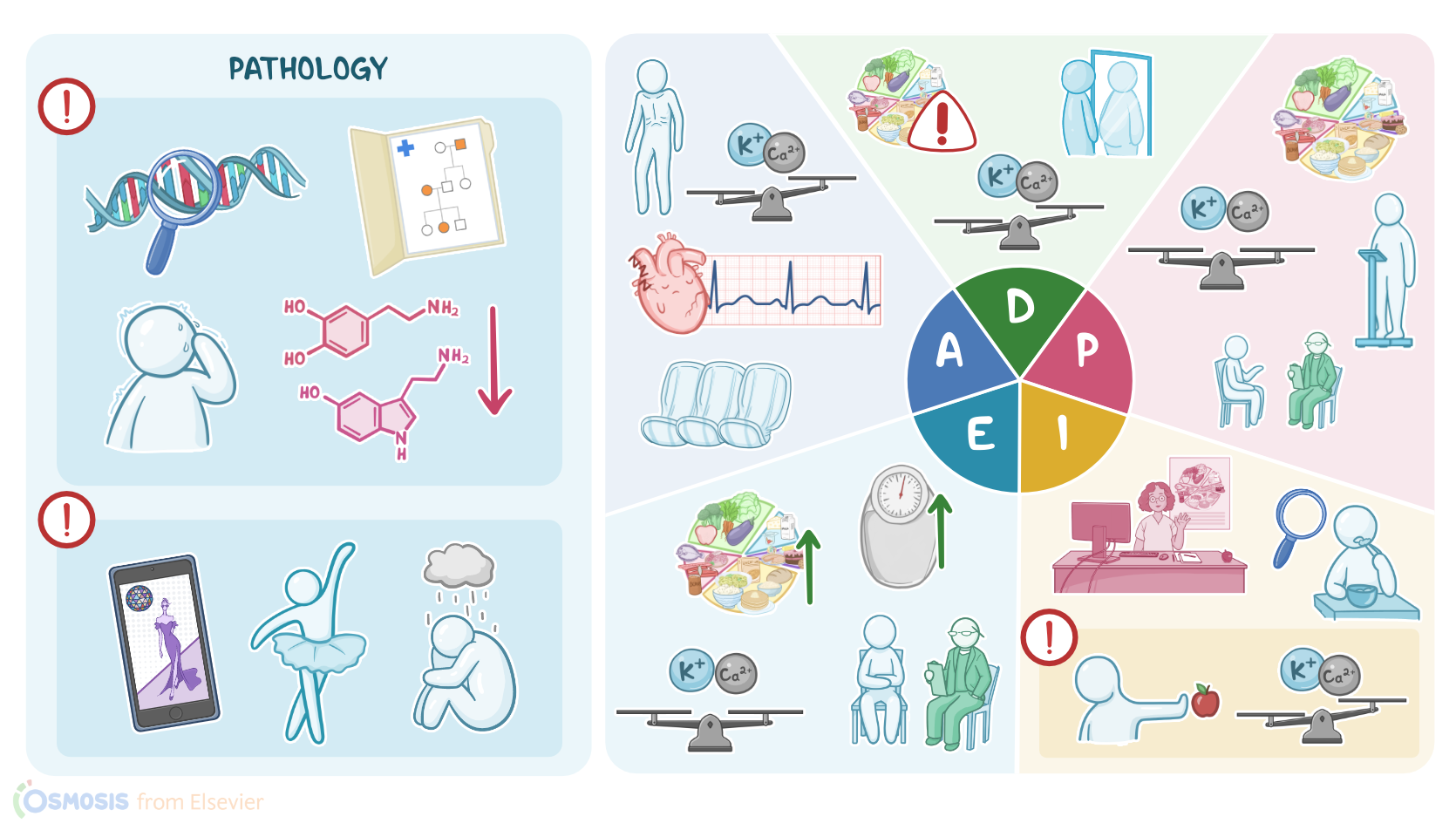
The most common eating disorders include anorexia nervosa and bulimia nervosa.Now, the exact cause of eating disorders is not well known, but they seem to be tied to both biological and environmental risk factors.
Biological risk factors include genetics and family history for an eating disorder, as well as associated mental health disorders like anxiety or obsessive compulsive disorder.
In addition, anorexia nervosa is thought to be associated with dysfunction in neural systems implicated in regulatory self-control and reward, which seems to be caused by a deficiency in neurotransmitters like serotonin and dopamine.
On the other hand, environmental risk factors include the psychosocial pressure to have a socially-defined “ideal body,” and having careers that promote weight loss, like modeling or sports, as well as experiencing childhood trauma, bullying, and loneliness, as well as stress and big life transitions or changes.Symptoms vary according to the specific eating disorder.
Anorexia nervosa is characterized by a constant fear of gaining weight, associated with a distorted body image, with individuals often believing that they are overweight, while actually being underweight, with a Body Mass Index or BMI lower than 18.5.
To avoid gaining weight, clients with anorexia may engage in two main compensatory behaviors. One is the restricting type, where clients reduce the amount of food they eat or over-exercise in order to lose weight without any purging.
The other is the binge-eating and purging type, where clients eat large amounts of food in one sitting and then purge that food through self-induced vomiting or by taking laxatives or diuretics, and this occurs recurrently for at least 3 months.Now, clients with bulimia nervosa also go through episodes of binge eating followed by compensatory behaviors to prevent weight gain, either by self-induced vomiting, over-exercising, or taking laxatives or diuretics; these episodes repeat consistently at least once a week for a period of 3 months; but still BMI is typically normal or high.Over time, eating disorders can result in several complications.
Clients with anorexia can become severely undernourished, leading to nausea and constipation, as well as amenorrhea and dry skin.
In addition, clients may have bone tissue loss, leading to osteopenia and osteoporosis; and muscle tissue loss throughout the body, which often manifests as fatigue, but can also weaken the diaphragm or the heart, leading to difficulty breathing, bradycardia, and heart or renal failure.
Prolonged food restriction can also lead to dehydration and depletion of electrolytes, which lead to hypotension. Also, the lack of essential nutrients can lead to iron deficiency anemia, or even pancytopenia.
Finally, prolonged anorexia can affect the brain, causing symptoms like confusion, irritability, or restlessness, as well as mental health problems like depression or anxiety.
Ultimately, individuals affected by anorexia nervosa may die from these complications or attempt suicide. With bulimia, repeated vomiting can lead to erosion of the dental enamel, and bilateral sialadenosis, which is the swelling of the salivary glands.
In individuals who use their hand to induce vomiting, the back of the knuckles can get calloused, which is called Russell’s sign.
Forceful vomiting can also lead to Mallory Weiss syndrome, which involves tearing of the distal esophagus and stomach itself, and can cause abdominal pain and hematemesis.
Over time, purging methods can cause dehydration and lead to hypotension, usually combined with tachycardia; as well as depletion of electrolytes, like potassium, or hypokalemia, which is particularly worrisome because it can lead to muscle weakness and even cardiac arrhythmias.
An excessive loss of gastric acid when vomiting might also lead to metabolic alkalosis.Diagnosis of eating disorders typically involves history and clinical presentation, and is based on the Diagnostic and Statistical Manual of Mental Disorders, Fifth Edition, or DSM-5.
However, lab tests can be useful to detect complications, including a complete blood count, coagulation panel, and metabolic profile, as well as electrolyte levels, and liver, kidney, and thyroid function tests.
In case of amenorrhea, a pregnancy test should be done to rule out pregnancy. An ECG can be performed to detect arrhythmias.Standard treatment for eating disorders involve nutritional rehabilitation and psychotherapy like cognitive behavior therapy, which aim at establishing healthy eating patterns, restoring a normal weight when necessary, and family therapy to help the client and their family structure a new relationship around food.
In addition, clients need to be monitored for treatment complications; in anorexia nervosa, a complication to watch for is refeeding syndrome, which occurs when trying to feed an undernourished client too aggressively, leading to rapid water and electrolyte shifts.
As a result, their blood levels can become dangerously low, and can be potentially fatal. Finally, clients with associated mental health problems like depression may benefit from medical treatment with antidepressants, such as selective serotonin reuptake inhibitors or SSRIs for short.Ok, let’s get back to assess Lily and see how she is doing.
Assessment6:42–8:26
She is tearful when you walk into her room, and she tells you she is fearful of eating and gaining weight during this admission.
You reassure her that you understand this can be a scary process and you are here to support her through it. Lily appears frail.
She is thin, pale and her skin is dry with poor turgor. She has 3+ pulses and capillary refill of three seconds.
She is 5 feet, 6 inches and weighs 99 pounds, or 44.9 kg. Her vital signs are oral temperature 97.7 F or 36.5 C; heart rate 44 beats per minute and regular; respiratory rate 14 breaths per minute and her lung sounds are clear; blood pressure of 92/58 mmHg; SpO2 is 97% on room air.An ECG is ordered, which shows sinus bradycardia.
Her last menstrual period was three months ago, and her urine pregnancy test is negative. Other lab values include glucose 75 mg/dL, calcium 8.2 mg/dL, sodium 140 mEq/L, potassium 3.4 mEq/L, chloride 98 mEq/L, phosphate 3.1 mg/dL, BUN 25 mg/dL, and creatinine 1.9 mg/dL.
You document your assessment findings, share the information with the admitting physician, and begin to develop a care plan for Lily.Based on the assessment data you collected, your nursing diagnoses include imbalanced nutrition related to inadequate nutritional intake; electrolyte imbalance related to inadequate nutritional intake; disturbed body image related to misconception of actual body appearance; and ineffective denial related to consequences of therapy and possible weight gain.Alright, now you’re ready to start planning goals for Lily’s care.
Diagnosis8:26–8:48
Short term goals for Lily include increased caloric and nutritional intake; balanced electrolytes; and Lily will participate in the treatment program and verbalize a recognition of her distorted perceptions of her body.
Planning8:48–9:17
Long term goals for Lily include stable body weight and independently establishing eating patterns that will meet her nutritional needs.Now it is time to implement your plan of care.
The physician has prescribed a combination of behavioral and psychological therapy as well as a feeding protocol, supplements, and close monitoring of intake and output, daily weights, and serum electrolytes.
You start by reviewing the plan of care with Lily, and you introduce her to the dietician, who describes the meal schedule and calorie goals in more detail.
Implementation9:17–10:26
You work with the rest of the healthcare team to establish a pleasant and relaxed environment, and will ensure she is monitored during and after mealtime.
While providing care, you encourage her to talk about her feelings regarding eating, her body, and weight, and you provide support for positive behaviors.
You will contact the physician immediately if Lily refuses to eat, attempts to vomit, or if there are signs or symptoms that indicate her condition is worsening such as unstable vital signs, syncope, continued weight loss or complications of refeeding such as decreasing electrolytes, paresthesia, or tremors.Okay, it’s been three weeks, so let’s check back and evaluate how Lily is doing so far.
Lily has increased her intake of calories and nutrition, and her current weight is 105 pounds. Her electrolytes are slowly stabilizing.
Lily’s been attending therapy sessions but not yet fully participating; although she has expressed occasional feelings of self-worth and some of her comments indicate she is starting to recognize some of her distorted perceptions about her body.
Evaluation10:26–11:07
Along with the interdisciplinary team, you continue to support Lily to reach her treatment goals until she can be discharged and transitioned to outpatient follow up.
Alright, as a quick recap … Your assigned client, Lily Truitt, was admitted to the medical psychiatric unit for treatment of anorexia nervosa.
Your assessment revealed a severely underweight client with bradycardia, electrolyte abnormalities, and distorted body image.
Your nursing diagnoses were imbalanced nutrition; electrolyte imbalance; disturbed body image; and ineffective denial. The goals you identified while planning care for Lily included weight gain, normalization of laboratory values, improved body image, and healthy eating patterns.
Summary11:07–11:48
You implemented interventions and will continue to evaluate the effectiveness of Lily’s plan of care. image.
Your nursing diagnosis for imbalanced nutrition, electrolyte imbalance Disturbed, body image and ineffective denial. The gold you identified while planning care for Lily, included weight, gain normalization, of laboratory values.
Improved body, image and healthy eating patterns, you implemented intervention and will continue to evaluate the effectiveness
| EATING DISORDERS | ||
| KEY POINTS | NOTES | |
| PATIENT REPORT |
| |
| PATHOPHYSIOLOGY |
| |
| DIAGNOSIS AND TREATMENT |
| |
| ASSESSMENT |
| |
| NURSING DIAGNOSES |
| |
| PLANNING |
| |
| IMPLEMENTATION |
| |
| EVALUATION |
| |
No notes for this video yet
Try adding a note below