Hypothyroidism: Nursing process (ADPIE)
Client Report0:00–0:27
Blythe Callaghan is a 71-year-old female client who presents to the primary care clinic with fatigue, weight gain, and constipation.
She also reports feeling cold and depressed and has spent the past few days in bed. After an examination by her physician and a review of laboratory results, Blythe is diagnosed with primary hypothyroidism.
Hypothyroidism is a condition in which the thyroid gland produces and releases low amounts of thyroid hormones. Now, hormonal production is normally regulated by the hypothalamus, which is located at the base of the brain.
Pathology0:27–9:12
When the hypothalamus detects low blood levels of thyroid hormones, it releases thyrotropin-releasing hormone, or TRH for short.
TRH then stimulates the anterior pituitary gland to release thyroid-stimulating hormone, or TSH, which in turn stimulates hormone production by the thyroid gland, a butterfly-shaped gland located in the neck.
The thyroid gland is made up of thousands of thyroid follicles, which release two iodine-containing thyroid hormones, triiodothyronine or T3, and thyroxine or T4, into the bloodstream.
These hormones then get picked up by nearly every cell in the body. Once inside the cell, T4 is mostly converted into T3, which is the active form.
T3 speeds up the cell’s basal metabolic rate by stimulating protein synthesis, and burning up more energy in the form of sugars and fats.
Other effects of thyroid hormones include increasing the cardiac output, stimulating bone resorption, as well as heat production and activating the sympathetic nervous system, which is responsible for our ‘fight-or-flight’ response.Now, hypothyroidism occurs when there’s low levels of thyroid hormones, which causes a slowing down of metabolic processes.
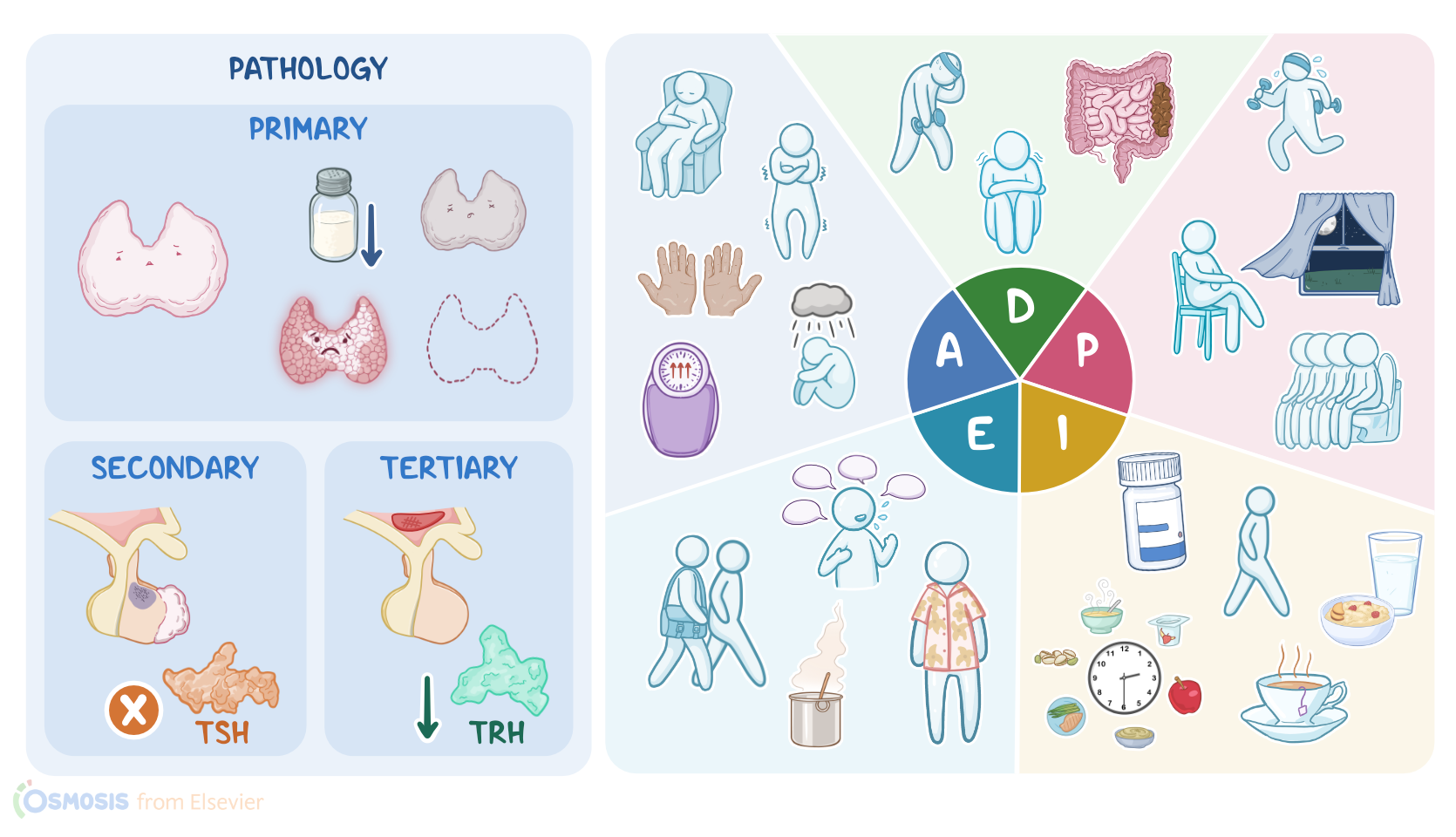
Hypothyroidism is usually either primary, secondary, or tertiary. In primary hypothyroidism, the problem is an underactive thyroid gland.
Now, the most common cause of primary hypothyroidism is nutritional iodine deficiency, especially in countries that don’t fortify food with iodine.
On the other hand, the most common cause of primary hypothyroidism in countries that fortify foods with iodine is Hashimoto thyroiditis, which is an autoimmune disorder against the thyroid gland, ultimately destroying it.
Another cause of primary hypothyroidism is thyroiditis, which is an inflammation of the thyroid gland. This may initially cause the release of thyroid hormones resulting in hyperthyroidism.
Later on, hormones will be depleted and the gland can no longer keep pace with the damage, which results in hypothyroidism.
Finally, primary hypothyroidism can be congenital, also called cretinism, which affects a newborn’s central nervous system development.
Most of the time it’s sporadic, but it can also be caused by an inherited genetic mutation. Ultimately, the newborn’s thyroid gland may be absent, underdeveloped, or unable to make enough thyroid hormones.
On the other hand, secondary hypothyroidism is usually due to an anterior pituitary gland tumor or infarction, which may prevent TSH production.
Finally, tertiary hypothyroidism occurs when there’s damage to the hypothalamus due to trauma or compression, leading to decreased TRH production.Now, there are some factors that increase the client’s risk of developing hypothyroidism.
For Hashimoto thyroiditis, risk factors include female sex, having a family history of Hashimoto thyroiditis, and having personal or family history for another autoimmune disorder like type 1 diabetes mellitus or celiac disease.
For thyroiditis, risk factors include viral upper respiratory tract infection, and pregnancy, which may lead to postpartum thyroiditis.
Other risk factors for hypothyroidism include certain medications like amiodarone or lithium, as well as radiation therapy for cancers in the neck region.
Finally, hypothyroidism can occur following treatment of hyperthyroidism, which may include surgical removal of the thyroid gland, use of radioactive iodine ablation, and the use of antithyroid medications like propylthiouracil and methimazole.Now, symptoms of hypothyroidism include modest weight gain despite a decreased appetite, as well as constipation due to decreased gastrointestinal motility.
In addition, clients may experience cold sensitivity because the body is producing less heat. Hypothyroidism also causes bradycardia, fatigue, and shortness of breath.
Often, clients may experience forgetfulness and decreased ability to concentrate, as well as paresthesia, or a feeling of “pins and needles” and numbness involving the limbs.
Some clients with hypothyroidism may present with a neck mass due to an enlarged thyroid, known as goiter. In addition, hypothyroidism leads to a build up of glycoaminoglycans in the interstitium of many tissues, resulting in myxedema, or swelling, in the skin and soft tissues like the tongue, as well as the vocal cords, which causes hoarseness.
In the skin, the build up of glycosaminoglycans leads to water retention and eventually a non-pitting edema. So, clients may have coarse and doughy skin, resulting in a puffy appearance with periorbital edema and dull facial expressions.
In addition, because blood flow to the skin is decreased, the skin becomes cool and dry. Over time, hypothyroidism may result in coarse and brittle hair, which can lead to hair loss.
In females, hypothyroidism can cause menstrual cycle irregularities, such as menorrhagia, in which menstrual bleeding is heavy or prolonged; or amenorrhea, where the menstrual cycle is absent.
In males, hypothyroidism can cause decreased libido, erectile dysfunction, and delayed ejaculation.If not treated, hypothyroidism can result in complications like anemia, as well as hypercholesterolemia, which can increase the risk of coronary heart disease.
Clients may also develop infertility, as well as mental health complications like personality changes and depressed mood.
In addition, a significant goiter can compress the trachea, causing difficulty breathing. Finally, one serious complication of inadequately treated hypothyroidism is myxedema coma.
This is a medical emergency where the body goes into a state of severe and profound slowing of metabolic processes, leading to cardiovascular collapse.
This is usually triggered by acute stress like surgery, infection, and trauma, and presents with hypothermia, hypotension, metabolic abnormalities like hypoglycemia and lactic acidosis, as well as worsening edema, seizures, impaired consciousness, and possibly coma.Diagnosis of hyperthyroidism is usually based on history and clinical findings, and can be confirmed via blood tests by measuring the levels of T3 and T4, which will be low, as well as TSH, which will be high in the case of primary hyperthyroidism, whereas in secondary and tertiary hyperthyroidism, TSH will most often be low.
Other diagnostic blood tests include a complete blood count to check for anemia, lipid profile to look for hypercholesterolemia, and serum electrolytes, which commonly show hyponatremia.
In addition, a radioactive iodine uptake test and a thyroid scan can be performed, which typically shows decreased thyroid uptake of radioactive iodine.
For Hashimoto thyroiditis, antibody testing can be done. Finally, because congenital hypothyroidism can be asymptomatic at birth, all newborns are typically screened by measuring serum TSH level within 24 to 48 hours of birth.Treatment for hypothyroidism is with thyroid hormone replacement therapy, primarily using levothyroxine, a synthetic T4.
The dose of thyroxine should be adjusted so that TSH is in the lower end or middle of the normal range.Okay, let’s get back to Blythe and begin your assessment.
Assessment9:12–11:02
As you enter the room, you observe that Blythe appears pale and is over-dressed for the current weather. You also notice that her speech pattern is slow and her responses to you are often mildly delayed.
When you ask her how she’s feeling, Blythe tells you that she’s been continually fatigued despite taking frequent naps. She shares that she’s felt depressed and unmotivated.
You observe periorbital edema on Blythe’s face as well as non-pitting edema to her hands and ankles bilaterally. Her skin is cool and dry.
Blythe’s current weight is 152 pounds or 68.9 kilograms, compared to her weight 3 months ago of 146 pounds or 66.2 kilograms.
Blythe begins to shiver after removing the extra clothing she’s wearing, and she tells you, “I can’t seem to get warm lately.” Her vital signs are oral temperature 97.6 F or 36.4 C; apical heart rate 54 beats per minute and regular; respirations 12 breaths per minute; blood pressure 112/68 mmHg; and SpO2 96% on room air.
When asked about her appetite, Blythe states she hasn’t felt like eating much lately. She also mentions that she hasn’t had a bowel movement in 4 days.
As you review her laboratory results you note these results: T-S-H five point two Milli-international units per liter and T-four three micrograms per deciliter TSH 5.2 mIU/L, and T4 3ug/dL.
You document your assessment findings and let her know the physician will be in shortly.With the assessment data you’ve collected, you are ready to create the following priority nursing diagnoses: activity intolerance related to decreased heat ; ineffective thermoregulation related to decreased heat production; and constipation related to decreased gastrointestinal motility.Next, you collaborate with Blythe and her physician to create a plan of care for Blythe with these goals: by her follow-up visit in 6 weeks, Blythe will experience improved activity tolerance; cold intolerance will be decreased; and her bowel elimination patterns will be well-regulated.After reviewing the physician’s orders, you begin implementing Blythe’s plan of care.
Diagnosis11:02–11:23
Planning11:23–11:43
Implementation11:43–13:28
The physician prescribed thyroid hormone replacement therapy using oral levothyroxine. You teach Blythe the importance of taking levothyroxine in the morning to mimic the body’s natural rise in thyroid hormone, and to take it on an empty stomach 30 to 60 minutes before breakfast to allow for proper absorption of the medication.
You explain that her current symptoms should begin to resolve in about two weeks as her thyroid hormone levels normalize, To help balance Blythe’s energy levels, you recommend consuming 6 small, low-calorie meals a day, to take rest periods as needed throughout the day, and to schedule activities for periods when she has the most energy.
Next, you teach Blythe the importance of maintaining a warm environment, and you encourage her to drink warm beverages, take warm baths, and to continue to wear additional layers as needed.
To address constipation, you teach Blythe to increase both dietary fiber and fluids, to slowly increase her activity as tolerated, and to take a stool softener recommended by her physician.
You instruct Blythe to notify her physician if she experiences worsening of her symptoms such as worsening cold intolerance, mental or cognitive changes or continued weight gain, as well as symptoms indicating her medication dose is too high, such as nervousness, insomnia, or palpitations.
Finally, you make an appointment for Blythe to return in 6 weeks to see if her symptoms are resolving, to have her TSH levels tested and to adjust the levothyroxine dosage if needed.It’s been 6 weeks since Blythe was diagnosed with hypothyroidism, so let’s check in with her to evaluate if the goals of her plan of care are being met.
Evaluation13:28–14:45
You immediately notice that Blythe’s skin is less pale, her speech pattern is normal, and she is smiling and talkative. You are also glad to see she is dressed appropriately for the weather.
Blythe is happy to tell you that she’s starting to feel more energized and she shares that her sister comes over daily to exercise with her and help her with meal preparation.
Her current weight is 149 pounds or 67.6 kilograms. Her vital signs are oral temperature 98.4 F or 36.8 C; apical heart rate 66 beats per minute and regular; respirations 16 breaths per minute; blood pressure 119/74 mmHg; and SpO2 98% on room air.
Lab results reveal that her TSH and T4 are within normal limits. Lastly, Blythe reports having regained her normal bowel elimination pattern and states the stool softener is no longer needed.##SummaryAlright, as a quick recap … Blythe Callaghan presented to her physician’s office with signs and symptoms of hypothyroidism, which is when the thyroid gland produces and releases low amounts of thyroid hormones.
Summary14:45–15:23
Your assessment revealed fatigue, weight gain, cold intolerance, and constipation. The priority nursing diagnoses you established were activity intolerance, ineffective thermoregulation, and constipation.
Careful planning allowed you to create
| HYPOTHYROIDISM | ||
| KEY POINTS | NOTES | |
| PATIENT REPORT |
| |
| PATHOPHYSIOLOGY |
| |
| DIAGNOSIS AND TREATMENT |
| |
| ASSESSMENT |
| |
| NURSING DIAGNOSES |
| |
| PLANNING |
| |
| IMPLEMENTATION |
| |
| EVALUATION |
| |
No notes for this video yet
Try adding a note below