Rubella (German measles): Nursing
Introduction0:00–0:25
Rubella, also known as German measles or the 3-day measles, is a mild viral childhood infection caused by the Rubella virus and is usually associated with malaise, fever, rash, and lymphadenopathy.
Thanks to vaccination, there are fewer cases of rubella, but in some parts of the world where the population is not immunized, it’s still possible to see outbreaks.Now, the cause of rubella is infection with the Rubella virus, which is an RNA virus that has recently been reclassified to the Matonaviridae family from the Togaviridae which it originally belonged to.
Causes & risk factors0:25–0:52
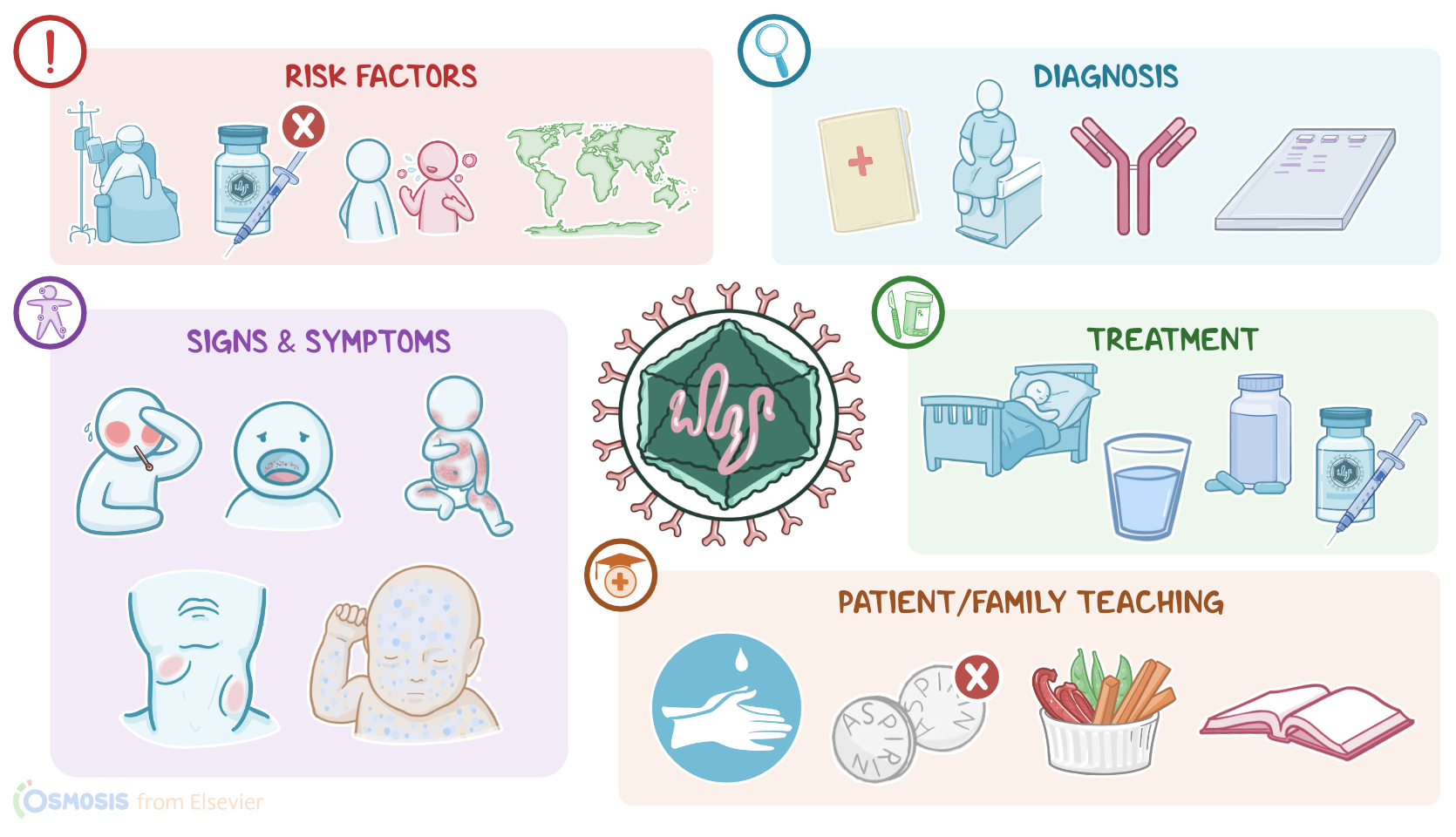
Important risk factors for rubella include immunodeficiency; being unvaccinated or incompletely vaccinated; coming in contact with an infected person; and finally, living in or traveling to an endemic area.Moving on to pathology.
Rubella virus is an airborne virus, meaning it spreads via small virus-containing droplets that get flung in the air when an infected person coughs or sneezes.
Pathology0:52–2:42
If another person breathes in these droplets, or they get in contact with infected surfaces and then touch their mouth, nose, or eyes, they can become infected.
Once the virus enters the body, it binds to a specific receptor on the membrane of epithelial cells in the nasopharynx and enters the cell.
Inside the cell, the virus replicates, creating new viral particles, which leave the cell and enter surrounding lymphatic and blood vessels, eventually reaching regional lymph nodes where they replicate once again.
From here, the virus enters blood vessels again, and spreads throughout the body, making its way into various bodily fluids like urine, cerebrospinal fluid, and synovial fluid of joints.
Important complications of rubella infection include polyarthritis and polyarthralgia. Now, the virus can also cross the placenta during pregnancy, causing congenital rubella syndrome, or CRS for short, in the fetus.
The risk of CRS is highest when the pregnant individual gets rubella during the first trimester. Infection during this time can lead to a triad of problems that include sensorineural hearing loss; cataracts; and congenital heart defects.
CRS can also result in miscarriage, stillbirth, low birth weight, hemolytic anemia, and microcephaly. In fact, rubella is among the most common infections that cause congenital defects in fetuses, which are grouped under the acronym TORCH.
T stands for Toxoplasmosis, O for Other infections like Syphilis, R for Rubella, C for Cytomegalovirus, and H for Herpes Simplex.Now, infection with the rubella virus is often asymptomatic.
Clinical manifestations2:42–4:04
After exposure, there’s an incubation period of 12 to 23 days, which is often followed by prodromal symptoms, including a low-grade fever, sore throat, mild conjunctivitis, and general malaise; along with petechiae, which can be noted on the the soft palate.
Then, maculopapular rash appears during day 14 to 17, which is made up of little pink or light red macules and papules that start on the face and spread downward to the trunk and extremities.
The lesions are usually discrete; but they can become more obvious after a hot shower or bath. The rash can also be accompanied by itching or minimal desquamation and it usually clears up in 2 to 4 days.
It’s important to note that shedding of the virus is likely happening 5 days before the rash appears and 6 days after the rash resolves, so this is when individuals with rubella are most likely to spread the virus to other people.
Other clinical features include symptoms of upper respiratory tract infection, like cough, and runny nose, as well as regional lymphadenopathy, or swelling of posterior cervical, postauricular, and occipital lymph nodes.
Finally, neonates born with CRS can have a characteristic “blueberry muffin” rash, characterized by numerous reddish-blue purpuric papules and macules.Diagnosis of rubella is typically based on the client’s history, and physical assessment, followed by detection of rubella-specific IgM antibodies, which indicate current infection.
Diagnosis4:04–4:25
Additionally, a PCR test can be used to detect viral RNA in amniotic fluid, fetal blood, or chorionic villi.Treatment is based on supportive care that includes rest and hydration, as well as medications, such as analgesics and antipyretics.
Treatment4:25–4:50
Finally, it’s important to note that rubella can be prevented via an MMR vaccine, which protects against measles, mumps, and rubella.
Management and care4:50–5:35
Your priority nursing goals are to prevent spread of the virus to others and provide supportive care.First, institute contact and droplet precautions to limit the spread of infection.
Then, start your assessment by asking about the presence of symptoms and when they first occurred. Next, review their vital signs, noting presence of fever and their current pain scale rating.
Provide fluids, encourage your client to rest, and administer the prescribed analgesic, antipyretic and antipruritic medications, as needed.
Lastly, determine their vaccination status. Finally, ensure the case has been reported to the local health department.Okay, moving onto client and family teaching.
General client and family teaching5:35–7:02
Begin by explaining that rubella is a mild viral infection, and reassure them that it usually goes away on its own. Then, teach them that the virus is spread through the air and through contact with infected surfaces; and review basic infection control techniques such as frequent hand hygiene, avoiding sharing food, drinks, and utensils, and helping their child cover their mouth when they cough or sneeze.
Let them know that their child will continue to be contagious 7 days after the rash has completely disappeared. Stress the importance of keeping their child away from anyone who is pregnant for the duration of the illness, and waiting untiI their child is no longer contagious before returning to daycare or school.
Next, teach them about how to care for their child at home. Let them know that their healthcare provider recommends over-the-counter medications such as ibuprofen and acetaminophen to help manage symptoms such as pain and fever.
Emphasize the importance of avoiding aspirin in order to prevent Reye syndrome, which can cause liver and brain damage. Also teach them to offer plenty of fluids and provide healthy snacks.
Instruct them to encourage their child to rest and engage in quiet activities like reading or coloring. Finally, encourage them to follow-up with their healthcare provider to get their vaccinations up to date, and teach them to contact their healthcare provider immediately if their child does not get well as expected or if they develop new or worsening symptoms.All right, as a quick recap… Rubella, also known as German measles, or the 3-day measles, is a mild viral childhood infection caused by the Rubella virus.
Review7:02–7:49
Rubella can be prevented by vaccination with the MMR vaccine, which protects against measles, mumps, and rubella. The rubella virus is transmissible through droplets, either inhaled or through contact with an infected surface.
Clinical findings include a maculopapular rash that starts on the face and spreads downwards to the trunk and extremities.
Treatment is based on supportive care. Priority nursing goals include preventing spread of the virus and providing supportive care.
Client and family teaching is focused on infection control, managing the infection at home, and when to contact the healthcare provider.
| RUBELLA (GERMAN MEASLES) | ||
| KEY POINTS | NOTES | |
| DEFINITION |
| |
| CAUSES AND RISK FACTORS |
| |
| PATHOPHYSIOLOGY |
| |
| SIGNS AND SYMPTOMS |
| |
| DIAGNOSIS |
| |
| TREATMENT |
| |
| MANAGEMENT OF CARE |
| |
| PATIENT AND FAMILY TEACHING |
| |
- "Wong’s Nursing Care of Infants and Children (12th ed.). ISBN: 978-0-323-77670-7 " Elsevier (2024)
- "Seidel’s guide to physical examination (10th ed). ISBN 978032376183" Elsevier (2023)
- "Habif’s Clinical Dermatology: A Color Guide to Diagnosis and Therapy. 7th edition. ISBN: 978-0-323-61269-2 " Elsevier (2020)
- "Essentials of Pediatric Nursing. 4th edition. ISBN: 978-1-975139-84-1 " LWW (2020)
- "Rubella (German measles) revisited. 25(2):134-141." Hong Kong Med J. (2019)
- "Fundamentals of nursing (10th ed.). ISBN 978-0323810340 " Elsevier (2021)
- "Critical care nursing: Diagnosis and management (9th ed). ISBN 978-0323642958 " Elsevier (2022)
No notes for this video yet
Try adding a note below