Anxiety disorders: Nursing process (ADPIE)
1,111views
Anxiety disorders: Nursing process (ADPIE)
exam 5
exam 5
Notes
| ANXIETY DISORDERS | ||
| KEY POINTS | NOTES | |
| PATIENT REPORT |
| |
| PATHOPHYSIOLOGY |
| |
| DIAGNOSIS AND TREATMENT |
| |
| ASSESSMENT |
| |
| NURSING DIAGNOSES |
| |
| PLANNING |
| |
| IMPLEMENTATION |
| |
| EVALUATION |
| |
Transcript
Georgia Ryan is a 22-year-old female client who presents to her college campus clinic with a report of an inability to sleep and difficulty concentrating for the past 9 months. Georgia says that lately she’s been self-isolating from fellow students and that she has stopped attending her classes the past few days. After a review of Georgia’s medical history and current symptoms, the advanced practice registered nurse, or APRN, diagnoses Georgia with generalized anxiety disorder.
Anxiety is the anticipation of a future threat or stressful situation with an uncertain outcome, and is often associated with feelings of fear, worry, and nervousness, which causes avoidant behaviors. Anxiety disorders are a group of disorders in which these feelings are disproportionate to the stressful situation, and can be accompanied by physical and psychological symptoms that are so severe as to interfere with day-to-day activities. The most common anxiety disorders include generalized anxiety disorder, panic disorder, and phobia-related disorders.
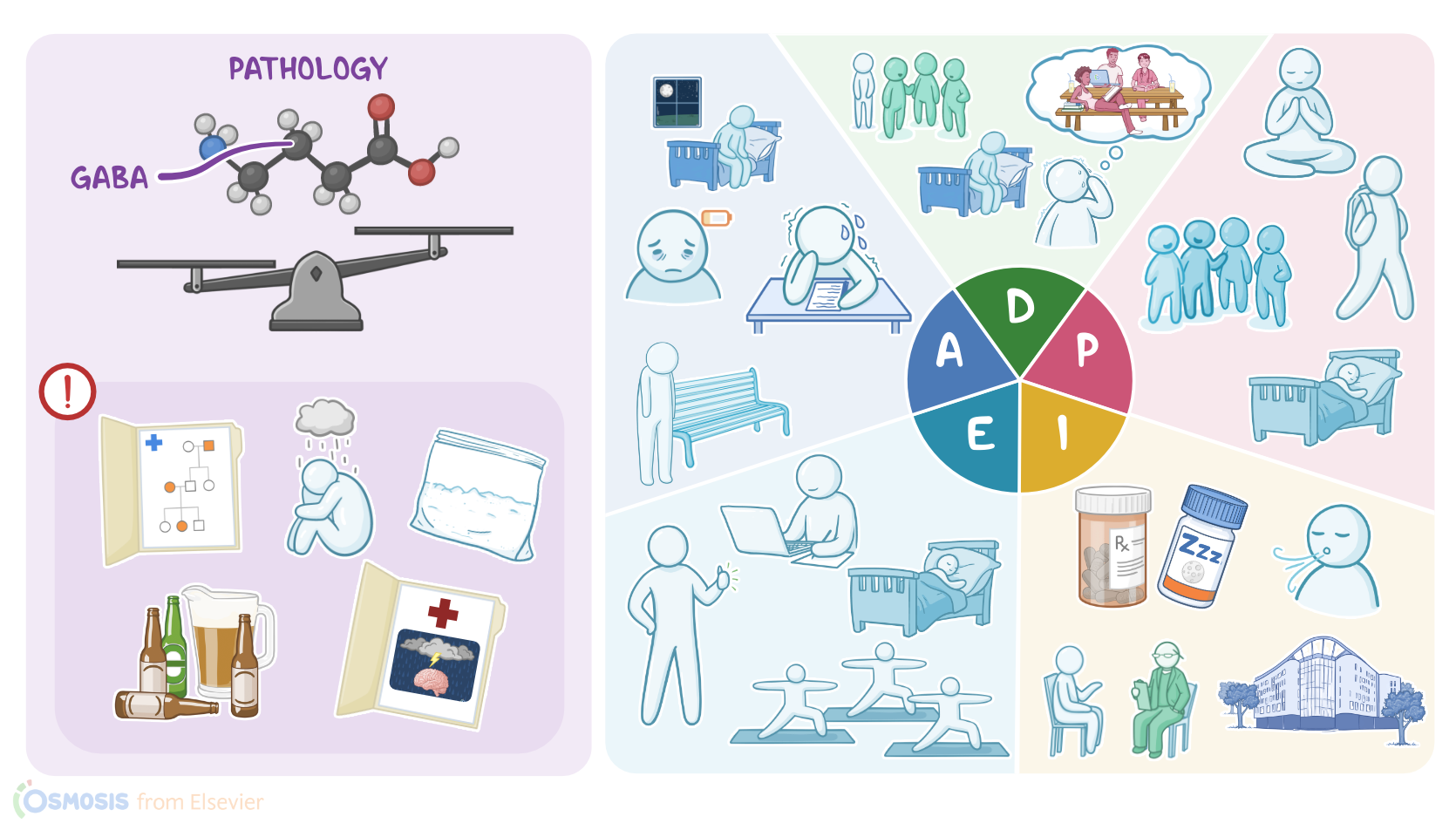
Now, the underlying cause of anxiety disorders is poorly understood, but it seems to be related to an imbalance of the neurotransmitter GABA. The main risk factors for anxiety disorders include having a family history of an anxiety disorder or experiencing a personal trauma. Other risk factors include having other mental health disorders, having medical conditions like hyperthyroidism or pheochromocytoma, and using or experiencing withdrawal of substances like alcohol or cocaine.
Anxiety disorders typically present with symptoms like excessive fear, worry, and nervousness that interfere with day-to-day activities, but there are slight variations between the different anxiety disorders. Clients with generalized anxiety disorder may experience restlessness, fatigue, difficulty concentrating, irritability, muscle tension, and trouble sleeping. These symptoms persist for at least 6 months.
On the other hand, panic disorder is characterized by recurrent episodes of sudden panic attacks with uncontrollable fear, which may cause symptoms like palpitations, chest or abdominal pain, sweating, trembling, shortness of breath, dizziness, chills or hot flashes, paresthesia or a “pins and needles'' sensation, as well as derealization or feelings of unreality, depersonalization or detachment from self, and a feeling of impending doom.
With phobia-related disorders, there’s an excessive fear or anxiety about a specific object or situation, like certain animals, insects, or objects, as well as certain situations, environments, or enclosed places.
There’s also social anxiety disorder, previously called social phobia, in which clients experience fear and anxiety caused by social situations where they feel judged or under scrutiny, such as meeting groups of new people or going on job interviews. Social anxiety disorder can be accompanied by selective mutism, which is when they fail to speak at specific social situations, such as at school or in public, and is usually more common in children under the age of 5.
Finally, clients may experience agoraphobia, meaning that they have an intense fear of public spaces, and they often fear they may not be able to leave or escape a situation if they have a panic attack.
Over time, anxiety disorders can lead to a number of complications, which include social isolation, academic or professional impairment, and an overall poor quality of life. In addition, clients may have difficulty sleeping, which can lead to fatigue. Finally, clients with anxiety disorders often develop other mental health disorders, like depression, substance misuse, personality disorders, and even suicidal ideation.
Diagnosis of anxiety disorders relies on history and clinical presentation, as well as diagnostic tools like the Mental Status Examination, or MSE, and the Diagnostic and Statistical Manual of Mental Disorders, the Fifth Edition, or DSM-5. To confirm the diagnosis, other causes must be ruled out first, which means that symptoms can’t be better explained by other psychiatric or medical conditions.
Treatment of an anxiety disorder typically involves psychotherapy, including cognitive-behavioral therapy or CBT for short, which focuses on teaching the client strategies to better cope with stress and social pressures, and to identify anxious patterns of thinking. In addition, lifestyle changes like having a regular sleep schedule and a healthy diet, as well as meditation, deep-breathing exercises, physical activity, and yoga have also shown benefits.
Some clients may also be treated with medications, such as selective serotonin reuptake inhibitors, or SSRIs, like fluoxetine, sertraline, citalopram, escitalopram, and fluvoxamine; as well as selective norepinephrine reuptake inhibitors, or SNRIs, like venlafaxine, duloxetine and desvenlafaxine. The second-line choice is tricyclic antidepressants, or TCAs for short, such as doxepin and amitriptyline. Medications are more effective when used along with CBT.
Sources
- "Ackley and Ladwig’s Nursing Diagnosis Handbook: An Evidence-Based Guide to Planning Care, 13th edition" Mosby (2022)
- "Aortic Coarctation: Basic Imaging Findings and Management" Journal of Radiology Nursing (2020)
- "Psychedelics: Alternative and Potential Therapeutic Options for Treating Mood and Anxiety Disorders" Molecules (2022)
- "Davis Advantage for Townsend’s Essentials of Psychiatric Mental-Health Nursing Concepts of Care in Evidence-Based Practice, Ninth edition" F.A. Davis Company (2022)
- "Anxiety disorders" Lancet (2021)
- "Anxiety Disorders in Older Patients" Prim Care Companion CNS Disord (2019)