Hyperthyroidism: Nursing process (ADPIE)
Client Report0:00–0:35
Suzanne Benoit is a 45-year-old female client who presents to her primary care clinic with a report of insomnia, anxiety, and unintentional weight loss.
She states she hasn’t felt like herself for the past few weeks, and reports occasional episodes of heart palpitations and hand tremors that she initially thought might be manifestations of panic attacks.
After an examination by her physician and a review of laboratory results, Suzanne is diagnosed with primary hyperthyroidism.
Hyperthyroidism is a condition in which the thyroid gland produces and releases excess thyroid hormones. Now, hormonal production is normally regulated by the hypothalamus, which is located at the base of the brain.
Pathology0:35–9:34
When the hypothalamus detects low blood levels of thyroid hormones, it releases thyrotropin-releasing hormone, or TRH for short.
TRH then stimulates the anterior pituitary gland to release thyroid-stimulating hormone, or TSH, which in turn stimulates hormone production by the thyroid gland, a butterfly-shaped gland located in the neck.
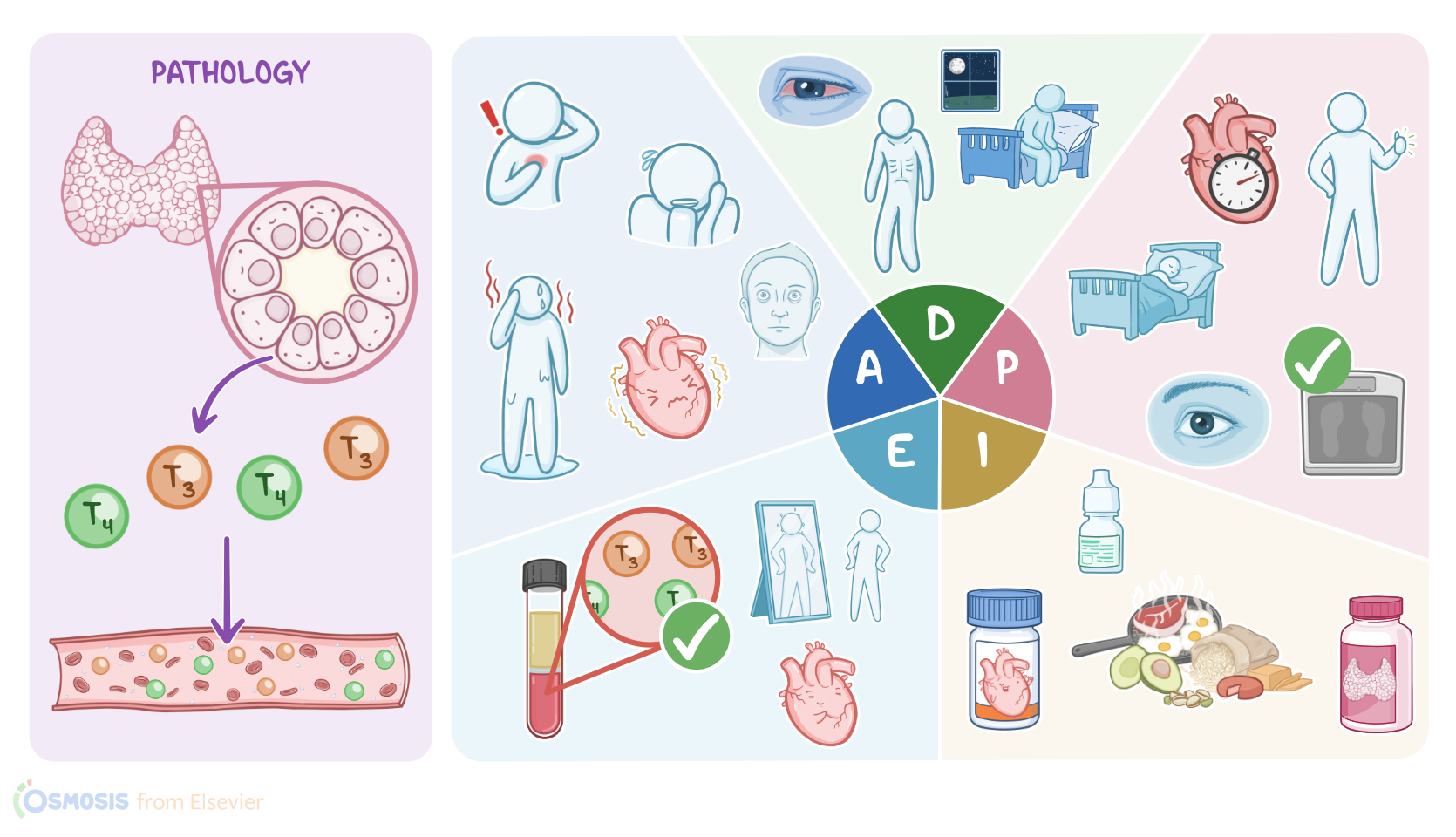
The thyroid gland is made up of thousands of thyroid follicles, which release two iodine-containing thyroid hormones, triiodothyronine or T3, and thyroxine or T4, into the bloodstream.
These hormones then get picked up by nearly every cell in the body. Once inside the cell, T4 is mostly converted into T3, which is the active form, and it can exert its effect.
T3 speeds up the cell’s basal metabolic rate by stimulating protein synthesis, and burning up more energy in the form of sugars and fats.
Other effects of thyroid hormones include increasing the cardiac output, stimulating bone resorption, as well as heat production and activating the sympathetic nervous system, which is responsible for our ‘fight-or-flight’ response.Now, hyperthyroidism occurs when there’s too much thyroid hormone, leading to a hypermetabolic state, in which cellular reactions are happening faster than normal.
Hyperthyroidism is usually either primary or secondary. In primary hyperthyroidism, the problem is an overactive thyroid gland.
Okay, the most common primary cause is Graves disease, an autoimmune disorder where autoantibodies bind to and activate TSH receptors, which ultimately stimulates the thyroid gland to produce excess thyroid hormones.
Another primary cause is toxic nodular goiter, where one or more follicles autonomously start generating lots of thyroid hormone.
Next is a hyperfunctioning thyroid adenoma, where the follicular cells start growing uncontrollably, forming a benign tumor that produces excess thyroid hormones.
In addition, anytime the thyroid gets damaged or inflamed, like in thyroiditis, there can be a large release of thyroid hormones.
On the other hand, in secondary hyperthyroidism, the underlying problem is in the anterior pituitary gland that’s releasing too much TSH.
One cause of secondary hyperthyroidism is a TSH-secreting tumor in the anterior pituitary gland, which stimulates a healthy thyroid to produce too much thyroid hormone.
Finally, there’s exogenous hyperthyroidism, which is caused by the excessive intake of exogenous thyroid hormones, like the medication levothyroxine.
Now, there are some factors that can put the client at risk of hyperthyroidism. For Graves disease, risk factors include female sex, having a family history of Graves disease, and having another autoimmune disorder like Type 1 diabetes mellitus or primary adrenal insufficiency.
For thyroiditis, risk factors include viral upper respiratory tract infection, and pregnancy, which increases the risk for postpartum thyroiditis.
Other risk factors for thyroiditis include certain medications like amiodarone or lithium , as well as radiation therapy for cancers in the neck region.Now, one of the most frequent symptoms of hyperthyroidism is weight loss, despite an increase in appetite, because of the higher basal metabolic rate, as well as diarrhea due to increased gastrointestinal motility.
In addition, clients may experience heat intolerance because the body is producing more heat, as well as sweating, hyperactivity, rapid heart rate and palpitations, anxiety, and insomnia because of the effect of thyroid hormones on the sympathetic nervous system.
Some clients with hyperthyroidism may present with a neck mass due to an enlarged thyroid, known as goiter. Upon auscultation, a bruit might be heard over a goiter because of the increased blood flow.
In females, hyperthyroidism can cause menstrual cycle irregularities, while in males, it can cause erectile dysfunction and gynecomastia, or breast enlargement.
Now, there are also unique symptoms to Graves disease, such as Graves’ ophthalmopathy, which occurs due to build-up of glycosaminoglycans, which are carbohydrates that attract water, leading to local swelling around the eyes.
This can manifest as exophthalmos, which is anterior bulging of the eyes, as well as chemosis, which is swelling and redness of the conjunctiva.
Graves disease can also cause pretibial myxedema, where the skin of the shin becomes swollen, red, and hard.If not treated, hyperthyroidism can put clients at risk of cardiac complications like heart failure or arrhythmias.
Another potential complication is osteoporosis, in which excessive bone resorption results in decreased bone density and increased risk of fractures.
In addition, a significant goiter can compress the trachea, causing difficulty breathing. Clients with Graves ophthalmopathy may present with visual impairment, such as double vision, or even vision loss.
In addition, exophthalmos can dry out the eyes and increase the risk of corneal ulcers. Finally, untreated hyperthyroidism can lead to thyroid storm, also called acute thyrotoxicosis or thyrotoxic crisis.
This is a medical emergency where the body goes into a state of severe hypermetabolism, which can be life threatening. This usually occurs during periods of acute stress such as infections, trauma and surgery, and presents with more severe symptoms of hyperthyroidism, as well as fever, arrhythmia, seizures, impaired consciousness, and possibly coma.Diagnosis of hyperthyroidism can be done based on history and clinical findings.
Next, the diagnosis can be confirmed by measuring blood levels of TSH, T3, and T4. In primary hyperthyroidism, T3 and T4 will be high, while TSH will be low due to the negative feedback inhibition exerted by the increased thyroid hormones on the anterior pituitary gland.
On the other hand, secondary hyperthyroidism that’s caused by an anterior pituitary gland tumor, will result in high or normal TSH, and high T3 and T4.
Other tests include a radioactive iodine uptake test and a thyroid scan, which help determine the specific cause of the hyperthyroidism.
For example, in Graves disease, the scan will show a diffuse and generalized uptake of radioactive iodine across the thyroid gland; whereas toxic nodular goiter and adenoma would present with a localized uptake; and thyroiditis, would result in decreased thyroid uptake of radioactive iodine as the gland’s follicles are actually destroyed.
Finally, an electrocardiograph, or ECG, can be done to assess for cardiac complications.Treatment varies based on the exact cause of hyperthyroidism, but generally involves medications like beta-blockers, such as propranulol propranolol, which rapidly decreases the symptoms.
In addition, clients may also get corticosteeroids corticosteroids like prednisolone to inhibit conversion of T4 to T3, as well as antithyroid medications, like propylthiouracil and methimazole, which decrease thyroid hormone synthesis.
Thyroid hormone synthesis can also be decreased with potassium iodide, also called Lugol solution. However, this is rarely used.
In some cases, radioactive iodine ablation can be performed to partially or completely destroy thyroid function, followed by replacement hormone therapy.
Finally, in clients with severe symptoms or a significant goiter, surgery can be done to remove the thyroid gland partially or completely via thyroidectomy.Now let’s get back to Suzanne and start her assessment.
Assessment9:34–12:16
As you enter the room, you notice that Suzanne is fanning her face while pressing one hand over her left chest. When you ask about her symptoms, Suzanne tells you that she’s been experiencing heat flashes accompanied by the feeling of a racing heart rate and palpitations.
She denies experiencing chest pain or shortness of breath. Her vital signs are: temporal temperature 99.1 F or 37.3 C, apical heart rate 108 beats per minute with occasional irregularity, respirations 18 breaths per minute, blood pressure 128/75 mmHg, and oxygen saturation 98% on room air.
An ECG reveals sinus tachycardia with occasional premature ventricular complexes, or PVCs. Suzanne expresses concern when she hears the ECG results, but you explain that tachycardia and PVCs are very treatable.
Throughout your conversation with Suzanne, you notice that she is unconsciously jiggling her leg and fidgeting with her fingers.
When you ask about her current anxiety level, Suzanne shares she’s been experiencing lots of nervous energy and has been struggling to sleep at night.
She also tells you that she’s had a significant increase in appetite, but is persistently losing weight without trying. Her current weight is 109 pounds or 49.4 kilograms, and her height is 5 feet 5 inches.
Suzanne reports that her usual weight is 125 pounds, or 56.7 kilograms. Examination of Suzanne’s eyes reveals bilateral exophthalmos.
You observe that she is able to fully blink without difficulty, her pupils are reactive to light, and her conjunctiva and cornea appear moist and intact without signs of irritation.
She denies any recent changes in her vision, but states that her eyes have been dry and sensitive. Suzanne also expresses emotional discomfort about the bulging appearance of her eyes, and tells you she is embarrassed to leave the house.
You assure Suzanne that the healthcare team will assist her in exploring available treatment options. Next, you review Suzanne’s laboratory results which show the following: TSH 0.04 mIU/L, T3 280 ng/dL, and T4 13 ug/dL.
After answering her questions, you document your assessment findings.After reviewing the assessment data you collected, you establish the following priority nursing diagnoses: risk for decreased cardiac output related to alteration in heart rate and rhythm; imbalanced nutrition: less than body requirements related to increased metabolic rate; insomnia related to anxiety; risk for dry eye related to tissue swelling and lid retraction; and situational low self-esteem related to alteration in body image.Next, you collaborate with Suzanne and her physician to create a plan of care to address Suzanne’s condition.
Diagnosis12:16–12:46
Planning12:46–13:17
By her follow-up appointment three weeks, Suzanne’s heart will be in sinus rhythm; she will have no further weight loss; her sleep, rest and activity cycles will be balanced; she will maintain moist eye membranes and remain free of ulcerations or corneal injury; and she will verbalize a positive view of herself in her current situation and report improved self-esteem.Let’s begin assisting Suzanne in meeting her goals by implementing the plan of care.
Implementation13:17–15:29
The physician has prescribed the oral beta-blocker propranolol to help control Suzanne’s heart rate and rhythm, and to help reduce tremulousness, anxiety, and heat intolerance.
You show her how to count her radial pulse at home, and instruct her to hold a dose if her heart rate is less than 60 beats per minute.
You instruct her to contact her physician if her heart rate is above 120 beats per minute or if she experiences medication side effects such as dizziness, syncope, or chest tightness.
Suzanne has also been prescribed the oral antithyroid medication, methimazole. You stress the importance of taking the dose as directed, and suggest that Suzanne set reminders on an electronic device for when to take them.
If, however, she forgets a dose, you instruct her to skip the missed dose if it is almost time to take another one, and to never take 2 doses at once.
To help Suzanne regain a healthy weight, you recommend consuming nutrient-dense foods such as meats, cheese, eggs, nuts, avocados, potatoes and whole grains.
You also teach her to weigh herself daily at a consistent time, and record the values to bring with her at her next appointment.
To address the exophthalmos, Suzanne’s physician has recommended use of lubricating eye drops during the day and the application of a gel ointment at night to protect her eyes during sleep.
You demonstrate how to properly instill the eye drops and ointment and direct Suzanne to wear sunglasses as needed to help reduce her eye sensitivity.
Finally, you provide an opportunity for Suzanne to discuss her feelings about how the altered appearance of her eyes has affected her self image.
You provide emotional support and explain that the exophthalmos may be slow to resolve, but will likely improve by taking the antithyroid medication.It’s been 3 weeks since Suzanne was diagnosed with hyperthyroidism, so let’s evaluate her success in meeting her goals.
Evaluation15:29–16:59
Suzanne tells you she has not experienced palpitations in the last two weeks, and she states she hasn’t experienced any side effects from the propranolol.
Her vital signs are: temporal temperature 98.6 F or 37 C, apical heart rate is regular at 74 beats per minute, respirations 16 breaths per minute, blood pressure 110/64 mmHg, and oxygen saturation of 99% on room air.
A follow-up ECG confirms that Suzanne’s heart is in normal sinus rhythm. Her eyes remain moist with no sign of irritation.
New lab results reveal that her TSH, T3, and T4 levels are normalizing. Suzanne’s current weight is 111 pounds or 50.3 kilograms.
As you converse with Suzanne, you notice she appears calm and relaxed with her hands resting on her lap. She is excited to tell you that she slept 7 consecutive hours last night and that she is finally starting to feel like herself again.
Suzanne reports the progress she has made so far has made her feel better about herself, and has felt confident enough to go out for dinner with friends.
You are happy to see the plan of care has supported Suzanne’s physical and emotional needs.##SummaryAlright, as a quick recap … Suzanne Benoit presented with signs and symptoms of hyperthyroidism, which is when the thyroid gland produces and releases excess thyroid hormones.
Summary16:59–17:58
Your assessment revealed tachycardia with PVCs, unintentional weight loss, anxiety, insomnia, exophthalmos, and altered body image.
The priority nursing diagnoses you established were: risk of decreased cardiac output, imbalanced nutrition: less than body requirements, insomnia, risk for dry eye, and situational low self-esteem.
Careful planning allowed you to create goals that focused on alleviating Suzanne’s physical and psychosocial symptoms. Implementation of the plan of care involved addressing her symptoms, decreasing circulating thyroid hormones, and providing support.
Finally, you evaluated that Suzanne’s plan of care was effective in promoting her well-being. the plan of care involved, addressing her symptoms, decreasing circulating, thyroid hormones, and providing support.
Finally, you evaluated that Suzanne's plan of care was effective in promoting her well-being,
| HYPERTHYROIDISM | ||
| KEY POINTS | NOTES | |
| PATIENT REPORT |
| |
| PATHOPHYSIOLOGY |
| |
| DIAGNOSIS AND TREATMENT |
| |
| ASSESSMENT |
| |
| NURSING DIAGNOSES |
| |
| PLANNING |
| |
| IMPLEMENTATION |
| |
| EVALUATION |
| |
No notes for this video yet
Try adding a note below