Acute kidney injury (AKI): Nursing process (ADPIE)

4,603views

Acute kidney injury (AKI): Nursing process (ADPIE)

Watch later

Watch later

Antihyperlipidemics - Statins: Nursing pharmacology
Antibiotics - Topical: Nursing pharmacology
Anxiolytics and sedative-hypnotics: Nursing pharmacology
Analgesics: Nursing pharmacology
Acetylcholinesterase inhibitors for myasthenia gravis: Nursing pharmacology
Antihistamines: Nursing pharmacology
Hematopoietic growth factors: Nursing pharmacology
Glucocorticoids and mineralocorticoids: Nursing pharmacology
Bronchodilators: Nursing pharmacology
Diabetic ketoacidosis (DKA): Nursing process (ADPIE)
Diabetes insipidus: Nursing process (ADPIE)
Oral antidiabetic medications - Alpha-glucosidase inhibitors: Nursing pharmacology
Oral antidiabetic medications - DPP-4 inhibitors: Nursing pharmacology
Oral antidiabetic medications - Biguanides and thiazolidinediones: Nursing pharmacology
Peripheral arterial disease (PAD): Nursing process (ADPIE)
Health promotion and illness prevention: Nursing
Growth hormone and somatostatin
Cortisol
Oral antidiabetic medications - Sodium-glucose co-transporter-2 (SGLT-2) inhibitors: Nursing pharmacology
Growth and development - Infant: Nursing
Congenital heart defects - Cyanotic: Nursing
Infant of a diabetic mother (IDM): Nursing
Hygiene - Bathing: Nursing skills
Hygiene - Ostomy care: Nursing skills
Hygiene - Perineal care: Nursing skills
Hygiene - Oral care: Nursing skills
Pharmacokinetics - Absorption: Nursing pharmacology
Pharmacokinetics - Elimination: Nursing pharmacology
Pharmacokinetics - Distribution: Nursing pharmacology
Pharmacokinetics - Metabolism: Nursing pharmacology
Pharmacodynamics: Nursing pharmacology
Vital signs - Pain: Nursing skills
Physical assessment - Thorax and lungs: Nursing
Hypertension: Nursing process (ADPIE)
Quality and safety: Nursing
Osteomyelitis: Nursing
Osteoarthritis: Nursing
Back pain: Pathology review
Osteoporosis: Nursing
Hip fractures: Nursing
Anemia - Macrocytic: Nursing
Bones of the upper limb
Acute kidney injury (AKI): Nursing process (ADPIE)
Chronic kidney disease (CKD): Nursing
Dialysis care: Nursing
Diuretics - Osmotic and carbonic anhydrase inhibitors: Nursing pharmacology
Renal clearance
Renal cancer: Nursing
Renal and urinary calculi: Nursing
Pyelonephritis: Nursing
Prerenal azotemia
Arterial blood gas (ABG) - Overview: Nursing
Rheumatoid arthritis (RA): Nursing process (ADPIE)
Physical assessment - Abdomen: Nursing

Notes

ACUTE KIDNEY INJURY (AKI)

KEY POINTS
NOTES
PATIENT REPORT
  • 58-year-old man
  • Back injury weeks ago
  • Daily ibuprofen
  • History hypertension and gastroesophageal reflux disease (GERD)
  • Losartan and omeprazole
  • Fatigue, headache, lower extremity edema, and decreased urine output
  • Temperature: 99.0 F (37 C) 
  • Heart rate: 98
  • Respiratory rate: 20
  • Blood pressure: 148/96 mmHg
  • BUN: 28 mg/dL (10 mmol/L)
  • Creatinine: 2.4 mg/dL (212 μmol/L)
  • Sodium: 124 mEq/L (124 mmol/L)
  • Potassium: 5.3 mEq/L (5.3 mmol/L)
  • pH 7.25
  • PCO2: 42 mmHg (5.6 kPa)
  • PO2: 85 mmHg (11.3 kPa)
  • HCO3: 20 mEq/L (20 mmol/L)
  • Urine specific gravity: 1.010
  • Diagnosis: AKI

PATHOPHYSIOLOGY
  • AKI
    • Sudden decrease in kidney function over hours or days
    • Impaired fluid, electrolyte, and acid-base balance
    • Build up of waste products in blood
  • Risk factors
    • Advanced age
    • Diabetes mellitus
    • Autoimmune diseases
    • Certain cancers
    • Uncontrolled hypertension
    • Heart, liver, or kidney disease
    • Nephrotoxic agents
  • Causes
    • Prerenal
    • Intrarenal
    • Postrenal

CLINICAL FEATURES AND COMPLICATIONS
  • Decreased urine output
  • Fluid overload 
  • Peripheral edema
  • Weight gain
  • Hypertension
  • Bounding pulse
  • Distended neck veins
  • Electrolyte imbalance
  • Permanent kidney damage
  • Death

DIAGNOSIS AND TREATMENT
  • Diagnosis
    • Laboratory tests
    • Ultrasound
    • CT
  • Treatment
    • Address underlying cause
    • Renal replacement therapy

ASSESSMENT
  • Lungs clear
  • No jugular venous distension
  • 2+ pedal and ankle edema
  • Clear, yellow urine
  • 45 mL retained urine
  • Temperature: 99.6 F (37.5 C)
  • Heart rate: 94
  • Respiratory rate: 16
  • Blood pressure: 144/90 mmHg
  • Oxygen saturation: 94% room air
  • Pain: 5/10
  • 195 lbs (88.5 kg)
  • 76 in (193 cm)
  • BUN: 30 mg/dL (10.71 mmol/L)
  • Creatinine: 2.6 mg/dL (229.8 μmol/L)
  • Sodium: 128 mEq/L (128 mmol/L)
  • Potassium: 5.5 mEq/L (5.5 mmol/L)
  • Urinalysis: casts, increased sodium, specific gravity 1.010
  • ECG: normal sinus rhythm

NURSING DIAGNOSES
  • Impaired fluid balance related to renal insufficiency
  • Electrolyte imbalance related to renal insufficiency 
  • Pain related to back injury 
  • Deficient knowledge related to medications

PLANNING
  • Balance intake and output
  • Normalize electrolytes
  • Verbalize understanding of medications

IMPLEMENTATION
  • Administer medications as prescribed
  • Track intake and output, daily weight
  • Monitor heart rhythm and electrolytes
  • Teach about hypertension and medications
  • Refer to physical therapy

EVALUATION


Transcript

Watch video only

You are assigned to take care for Maurice Jones, a 58-year-old Black male, who sustained a back injury several weeks ago while cleaning out his garage, and since then he’s been taking ibuprofen three to four times each day for pain. Mr. Jones has a history of hypertension for which he takes the angiotensin II receptor blocker, or ARB, losartan, though he says sometimes he forgets to take it. He also takes the proton pump inhibitor, or PPI, omeprazole, for gastrointestinal reflux disease, or GERD. He presented to his primary care provider, or PCP, with fatigue, headache, lower extremity edema, and decreased urine output.

His vital signs were oral temperature 99.0 F or 37 C, heart rate 98 beats per minute, respiratory rate 20 breaths per minute and blood pressure 148/96mmHg. Labs were ordered which showed BUN 28 mg/dL, creatinine 2.4 mg/dL, sodium 124 mEq/L, and potassium 5.3 mEq/L. Arterial blood gas analysis revealed pH 7.25, PCO2 32, PO2 85, HCO3 30. Urine specific gravity is 1.010. Mr. Jones was admitted to the medical unit with a diagnosis of acute kidney injury, or AKI.

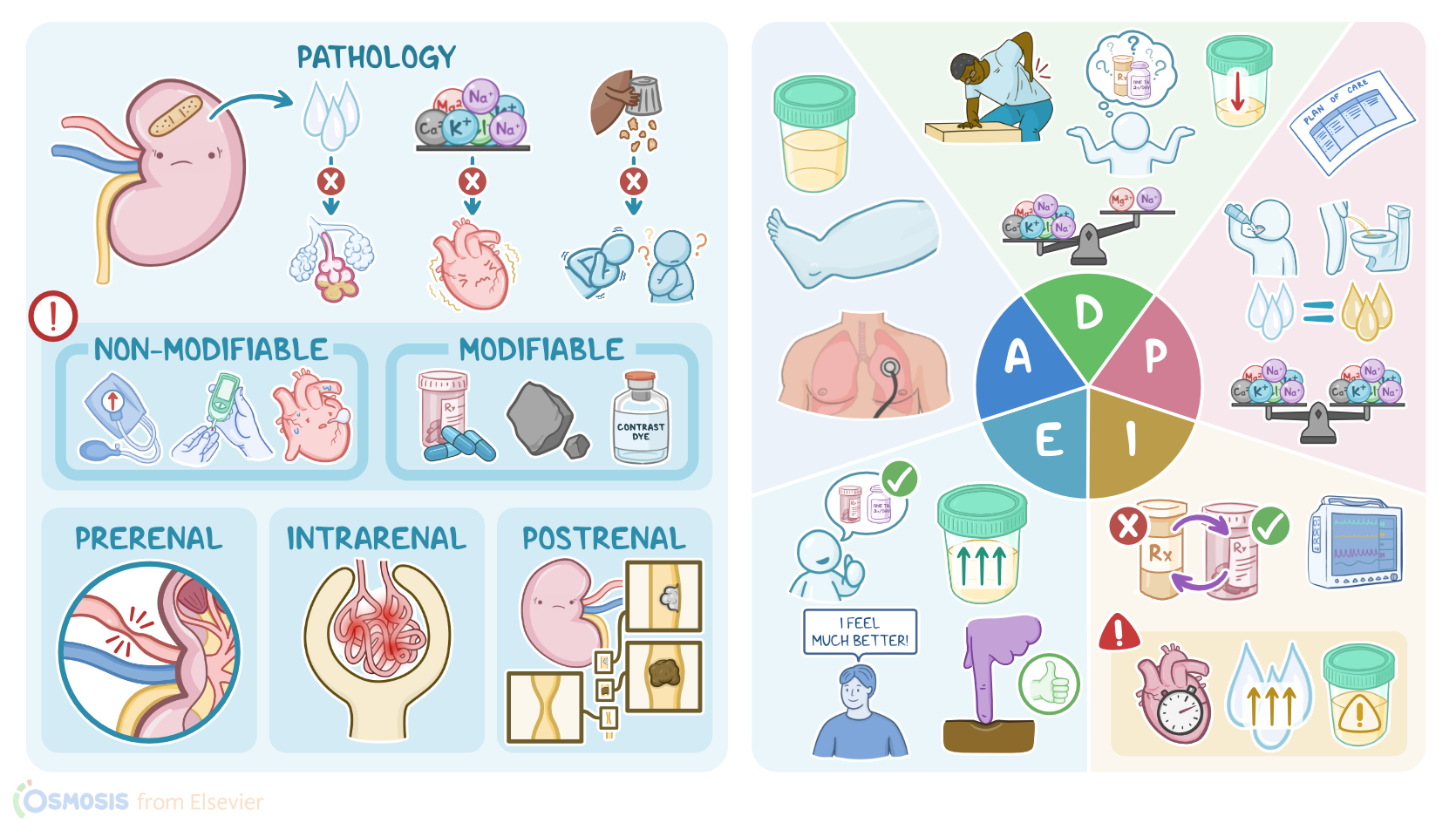
Acute kidney injury, or AKI for short, refers to a sudden decrease in kidney function over hours or days. As a result, the kidney’s ability to manage fluid, electrolyte, and acid-base balance is impaired, and there’s decreased excretion of waste products, such as urea and creatinine, which build up in the blood.

There are some factors that can put an individual at risk for AKI. Unfortunately, many of them are non-modifiable factors that decrease kidney function over time, such as advanced age, diabetes mellitus, autoimmune diseases, certain cancers, uncontrolled hypertension, and heart, liver, or kidney disease. Some modifiable risk factors include exposure to nephrotoxic agents, such as certain antibiotics, heavy metals, or chemotherapy or being exposed to iodinated IV contrast dye during radiology procedures.

Now, the causes of AKI can be classified into prerenal, intrarenal, and postrenal. In prerenal AKI there is no physical problem with the kidneys themselves, but the problem is caused by decreased blood flow to the kidneys. This can happen when there’s a severe loss of body fluid due to problems like hemorrhage, burns, or ascites. Other common causes involve decreased cardiac output, like with heart failure, myocardial infarction, or shock. Intrarenal AKI occurs due to damage to the kidney itself. Some common causes include inflammatory problems like glomerulonephritis and damage done by toxins, or prolonged ischemic injury. Finally, postrenal AKI occurs due to decreased outflow of urine from the kidneys. This can be a result of something compressing the ureter, like tumors, strictures, or an enlarged prostate, or from an obstruction caused by kidney stones lodged in the ureters.

AKI generally progresses through three phases, oliguric, diuretic, and recovery. Often the first sign of AKI is decreased urine output, which can lead to fluid overload, peripheral edema, and weight gain, as well as hypertension. A bounding pulse and distended neck veins could also be present. Over time, this can lead to complications like pulmonary edema, which causes dyspnea and tissue hypoxia.

Next, electrolytes can also become imbalanced since the damaged kidneys aren’t able to excrete them effectively from the body. Those who develop hyperkalemia may experience muscle weakness and dangerous cardiac arrhythmias. In addition, phosphate retention leads to hyperphosphatemia, which can ultimately lead to hypocalcemia, resulting in tetany, which are involuntary muscle cramps. As uremic waste products build up in blood, the client can experience symptoms like anorexia or appetite loss, nausea, and vomiting, as well as uremic encephalopathy, which is initially characterized by confusion and lethargy, and may progress to seizures and even coma. Finally, if AKI is not treated, it may progress to permanent kidney damage or end-stage renal disease, and death.

The main diagnostic studies used for AKI include standard laboratory tests that can show abnormal electrolyte levels like hyperkalemia, hyperphosphatemia, and hypocalcemia. Blood urea nitrogen, or BUN, and creatinine will also be elevated. A blood gas analysis can show metabolic acidosis. In addition, urinalysis can reveal proteinuria, hematuria, and casts. Finally, imaging techniques like an ultrasound or CT scan can assess renal blood flow and allow identification of an underlying cause.

Key Takeaways

Acute kidney injury (AKI) is a sudden, potentially reversible decline in renal function. AKI results in the accumulation of water, nitrogenous wastes, sodium, and other metabolic wastes in the body, and can also lead to electrolyte imbalances. Common causes include dehydration, sepsis, and some drug therapy.

AKI often presents with reduced urine output, but there can be other signs such as edema, and those associated with the accumulation of metabolic wastes such as anorexia, seizures, and altered mental status. The nursing process for AKI begins with the assessment and identification of patients at risk for developing the condition. Once AKI is diagnosed, nurses work with other health care providers to implement therapies aimed at preventing progression and maximizing patient outcomes. If AKI is left untreated, it can lead to chronic kidney disease (CKD).

Sources

  1. "Diagnosing the Diagnostic and Statistical Manual of Mental Disorders: Fifth Edition" Routledge (2019)
  2. "Saunders Comprehensive Review for the NCLEX-RN Examination" Elsevier (2022)
  3. "Critical care nursing: Diagnosis and management (9th ed)" Elsevier (2022)
  4. "Harrison’s principles of internal medicine" Mcgraw Hill (2022)
  5. "Sepsis associated acute kidney injury" BMJ (2019)
  6. "Acute kidney injury in the critically ill: an updated review on pathophysiology and management" Intensive Care Medicine (2021)
  7. "Robbins Basic Pathology" Elsevier (2017)