Guillain-Barré syndrome: Nursing
Introduction0:00–0:22
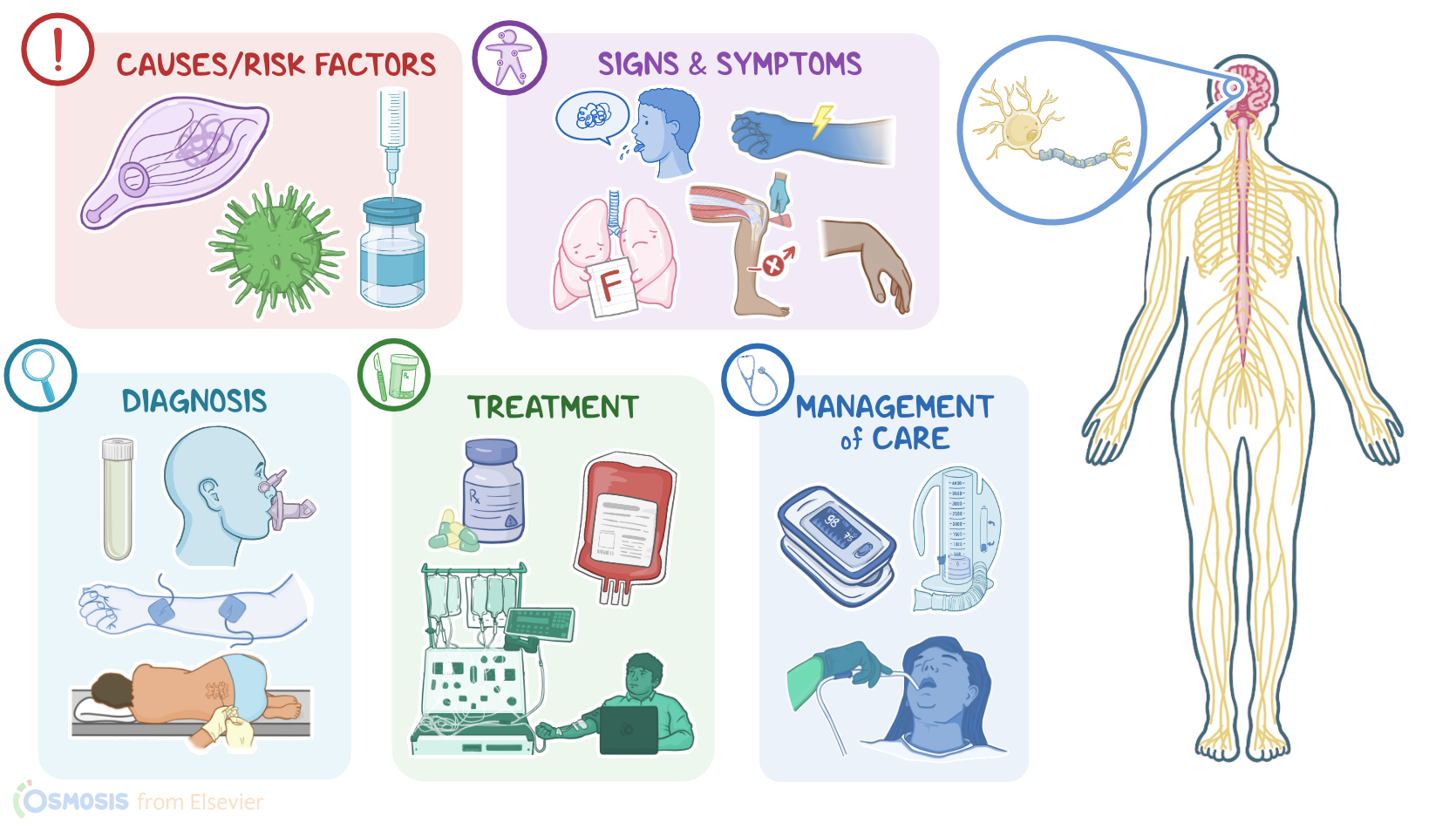
Guillain-Barré syndrome, or GBS for short, is a rare but potentially serious autoimmune disease characterized by acute demyelination and degeneration of the peripheral nerves, which ultimately leads to muscle weakness and even paralysis.Now, let’s quickly review the anatomy and physiology of the peripheral nervous system, which includes all of the neurons that extend beyond the brain and the spinal cord.
Physiology0:22–1:30
Neurons are made up of three main parts, the dendrites, cell body, and axon. The dendrites are little branches that receive nerve impulses, or signals from other neurons, and carry them to the cell body, which has all of the neuron’s main organelles.
This myelin is produced by Schwann cells, which are a group of cells that support neurons. For peripheral nerves, the cell body can either be located in the spinal cord, and this is called a spinal nerve; or the brain, which is called a cranial nerve.Alright, so Guillain-Barré syndrome is caused by demyelination of the peripheral nerves.
Causes & Risk factors1:30–2:09
The underlying cause of this demyelination isn’t clear, but there are some known risk factors and triggers, such as a recent bacterial infection, like Campylobacter jejuni and Mycoplasma pneumoniae, as well as a viral infection, like cytomegalovirus and Epstein-Barr virus, and in rare cases, clients may also develop Guillain-Barré syndrome soon after getting a vaccine, such as the flu vaccine.Okay, now these bacteria and viruses don’t directly damage the myelin sheath.
Pathology2:09–2:42
Instead, it’s thought that they have antigens on their surface that look similar to the lipids in the myelin sheath, so immune cells and antibodies can mistakenly attack and destroy the myelin sheath surrounding peripheral nerves.
As a result, nerve impulses become slow and sluggish, and ultimately, there’s degeneration of the peripheral nerves.Signs and symptoms of Guillain-Barré syndrome typically occur days to weeks after the trigger, and they typically present with acute, ascending, bilateral weakness - that starts with the lower limbs, then upper limbs, and the rest of the body.
Clinical manifestations2:42–4:55
This weakness is rapidly progressive, and in severe cases, clients may develop difficulty moving, walking, or even flaccid paralysis, as well as decreased or absent deep tendon reflexes in the affected limbs.
The cranial nerves can also be involved, causing symptoms like double vision and difficulty speaking. In addition, weakness of the pharyngeal muscles causes difficulty swallowing and increases the risk of aspiration.
In severe cases, nerves supplying the respiratory muscles like the diaphragm can be involved, leading to difficulty breathing and potentially respiratory failure.
In addition, when sensory nerves are affected, there’s a loss of sensation, or numbness, and paresthesia, or a feeling of pins and needles, and some clients may even feel pain.
Finally, some clients may experience autonomic dysfunction involving various organs, leading to symptoms like constipation and urinary incontinence, as well as cardiac arrhythmias, fluctuations in blood pressure like hypo- or hypertension, and diaphoresis or increased sweating.Typically, symptoms of Guillain-Barré syndrome tend to get worse over the next days to weeks, and then start to improve.
Most clients completely recover, usually in 4 months to 2 years, as the myelin regenerates. Unfortunately, some clients may retain permanent sequelae, and a minority of cases may result in death from acute complications, such as respiratory failure or infection, as well as pulmonary embolism, and cardiac arrest.Diagnosis of Guillain-Barré syndrome starts with history and physical assessment, followed by a lumbar puncture to obtain cerebrospinal fluid or CSF.
Diagnosis4:55–5:41
The CSF typically shows an albuminocytologic dissociation, which means that there’s an increase in protein or albumin levels, without an increase in white blood cells.
In addition, nerve conduction tests and electromyographic studies can be done to assess nerve and muscle function, but sometimes these tests can be normal early on in the disease.
In addition, pulmonary function tests can be done to evaluate an individual’s respiratory function.Treatment of Guillain-Barré syndrome is aimed at reducing the symptoms, and involves medications that suppress the immune system, such as corticosteroids.
Treatment5:41–6:26
Some clients can also be treated with intravenous immune globulins or IVIGs, in order to quickly neutralize the troublesome antibodies; or with plasmapheresis, or plasma exchange to filter out the circulating antibodies from the client’s blood.
Finally, clients are also monitored closely for any sign of respiratory failure and they are provided with ventilatory support in case of breathing difficulties, as well as hemodynamic support as needed.Alright, now let’s look at nursing care for a client with Guillain-Barré syndrome.
Management of care6:26–11:32
The main goal of nursing care is to provide support and to prevent and manage problems caused by autonomic dysfunction. One of the first priorities is to support ventilation and oxygenation.
Begin by assessing your client’s respiratory rate and depth, breathing pattern, breath sounds, oxygen saturation, and lung vital capacity, and review their arterial blood gas or ABG analysis.
Then, assess their ability to take a deep breath and hold it, and encourage them to regularly perform coughing and deep breathing.
Also assess their gag and swallowing reflex, and keep the head of their bed raised to at least 30 degrees to prevent aspiration.
Have suction equipment readily available to remove secretions as needed. Continue to monitor for signs that your client needs additional support, and be prepared to assist with intubation and mechanical ventilation.
Report concerning assessment findings, such as a respiratory rate below 12 or above 20 breaths per minute, abnormal breathing pattern, blood oxygen saturation below 90%, ABGs indicating respiratory acidosis, and signs of hypercapnia, like headache and agitation.
Next, monitor your client for cardiovascular complications, such as arrhythmias and blood pressure instability. Place your client on a cardiac monitor so you can regularly assess their heart rate and rhythm; and closely monitor their blood pressure every 2 hours or more as indicated.
Promptly report to the health care provider if your client’s heart rate is below 60 beats per minute or above 100 beats per minute, or if your client has a change in heart rhythm or blood pressure; and administer fluid boluses and medications ordered to support normal blood pressure and perfusion.
Additionally, be sure to closely monitor your client for complications that arise from immobility. Assist them to change position every two hours.
In addition, be sure to regularly assess their lower extremities for manifestations of deep vein thrombosis, such as warmth, swelling, and reddened or darkened skin around a painful area.
Monitor for any indication of a pulmonary embolism, such as anxiety along with a sudden onset of dyspnea, or a report of chest pain.
Provide preventative care by applying anti-embolism stockings, performing range of motion exercises, and administering low molecular weight heparin, as prescribed.Also assess your client for autonomic dysfunction of their gastrointestinal and urinary tracts.
In addition, assess the client's ability to chew and swallow without difficulty. Encourage small bites if they are able to eat safely; if unable to eat safely confer with the healthcare provider for a swallowing consult, intravenous fluids, tube feedings, or parenteral nutrition.
Assess for clinical manifestations of paralytic ileus, and promptly report lack of bowel sounds, constipation, and nausea.
Closely monitor their nutritional status, weigh them daily, and track their blood albumin levels.Also monitor your client’s urinary output and report signs of urinary retention, such as urine output of less than 30 mL per hour.
Insert an indwelling urinary catheter as ordered, provide fluids, and continue to monitor their intake and output, as well as their blood electrolytes.Now, another priority is regular pain assessments.
General Client and family teaching11:32–12:50
Assess the level and characteristics of their pain, and intervene by promoting relaxation, repositioning them as needed, and administering prescribed pain medications.During treatment, provide encouragement and support for your client, and reassure them that in most cases, symptoms eventually resolve.
Finally, administer the prescribed IVIG or assist with preparing your client for plasmapheresis, as ordered. Alright, moving on to client and family teaching.
Reassure them that most clients slowly recover over weeks to months. Teach them how working with physical and occupational therapists can help them regain functionality and mobility, and promote their ability to carry out their activities of daily living.
Remind them of the importance of pacing their activities and taking time to rest in order to prevent fatigue during recovery.
Review12:50–14:25
Also encourage them to join local support groups for people who are recovering from Guillain-Barré syndrome. Finally, emphasize the importance of reporting symptoms like increased weakness, numbness or tingling in their extremities, dizziness, shortness of breath, trouble urinating, constipation, or a fever of 100.4 F, or 38 C, or higher.Alright, as a quick recap… Guillain-Barré syndrome is an autoimmune disease that occurs after a bacterial or viral infection or rarely after getting vaccines such as the flu vaccine.
Antibodies attack the myelin sheath of peripheral neurons, leading to demyelination of these neurons and slowed nerve conduction.
This results in symptoms that include ascending, bilateral weakness that starts with the lower limbs, then upper limbs, and the rest of the body.
In serious cases, clients can develop flaccid paralysis or respiratory failure. Treatment of Guillain-Barré syndrome involves medications to suppress their
| GUILLAIN-BARRE SYNDROME | ||
| KEY POINTS | NOTES | |
| DEFINITION |
| |
| PHYSIOLOGY |
| |
| CAUSES AND RISK FACTORS |
| |
| PATHOPHYSIOLOGY |
| |
| SIGNS AND SYMPTOMS |
| |
| DIAGNOSIS |
| |
| TREATMENT |
| |
| MANAGEMENT OF CARE |
| |
| PATIENT AND FAMILY TEACHING |
| |
No notes for this video yet
Try adding a note below