Inflammatory bowel disease - Crohn disease and ulcerative colitis: Nursing

2,418views

Inflammatory bowel disease - Crohn disease and ulcerative colitis: Nursing

MS LEC PRELIMS 2nd SEM

MS LEC PRELIMS 2nd SEM

Esophageal disorders: Pathology review
Achalasia: Year of the Zebra
Paraesophageal and hiatal hernia: Clinical sciences
Hiatal hernia: Nursing process (ADPIE)
Gastroesophageal reflux disease (GERD)
Gastroesophageal reflux disease: Clinical sciences
Gastroesophageal reflux disease (GERD): Nursing process (ADPIE)
GERD, peptic ulcers, gastritis, and stomach cancer: Pathology review
Case study - Gastroesophageal reflux disease (GERD): Nursing
Esophageal cancer
Esophageal cancer: Nursing
Esophageal cancer: Clinical sciences
Gastrointestinal system: GI system disorders
Peptic ulcers, gastritis, and duodenitis (pediatrics): Clinical sciences
Gastritis: Clinical sciences
Peptic ulcer
Peptic ulcer disease: Clinical sciences
Peptic ulcer disease (PUD): Nursing process (ADPIE)
Gastric cancer
Gastric cancer: Clinical sciences
Gastric cancer: Nursing
Appendicitis
Appendicitis: Clinical sciences
Appendicitis: Pathology review
Appendicitis: Nursing process (ADPIE)
Case study - Pediatric appendicitis: Nursing
Diverticulosis and diverticulitis
Diverticular disease: Pathology review
Diverticulitis: Clinical sciences
Diverticular disease: Nursing
Approach to pneumoperitoneum and peritonitis (perforated viscus): Clinical sciences
Inflammatory bowel disease - Crohn disease and ulcerative colitis: Nursing
Crohn disease
Inflammatory bowel disease (Crohn disease): Clinical sciences
Ulcerative colitis
Inflammatory bowel disease (ulcerative colitis): Clinical sciences
Inflammatory bowel disease: Nursing pathophysiology
Bowel obstruction
Intestinal obstruction: Nursing
Small bowel obstruction: Clinical sciences
Hemorrhoids: Clinical sciences
Colorectal cancer
Colorectal cancer: Clinical sciences
Colorectal cancer: Nursing
Colorectal cancer screening: Clinical sciences
Colorectal polyps and cancer: Pathology review
Cleft lip and palate: Nursing
Esophageal atresia and tracheoesophageal fistula: Year of the Zebra
Esophageal atresia and tracheoesophageal fistula: Nursing
Hirschsprung disease
Hirschsprung disease: Year of the Zebra
Hirschsprung disease: Nursing
Intestinal atresia
Intussusception
Intussusception: Clinical sciences
Endocrine system anatomy and physiology
Endocrine system: Structure and function
Endocrine system: Hormone insufficiency and excess
Diabetes insipidus
Diabetes insipidus: Clinical sciences
Diabetes insipidus: Nursing process (ADPIE)
Diabetes insipidus and SIADH: Pathology review
Syndrome of inappropriate antidiuretic hormone secretion (SIADH)
Syndrome of inappropriate antidiuretic hormone secretion: Clinical sciences
Syndrome of inappropriate antidiuretic hormone (SIADH): Nursing process (ADPIE)
Hypothyroidism
Hypothyroidism: Pathology review
Approach to hypothyroidism: Clinical sciences
Hypothyroidism: Nursing process (ADPIE)
Case study - Hypothyroidism: Nursing
Hypothyroidism medications
Hyperthyroidism
Hyperthyroidism: Pathology review
Approach to hyperthyroidism and thyrotoxicosis: Clinical sciences
Hyperthyroidism: Nursing process (ADPIE)
Hyperthyroidism medications
Parathyroid disorders and calcium imbalance: Pathology review
Hypoparathyroidism
Hypoparathyroidism: Nursing
Hyperparathyroidism
Hyperparathyroidism: Clinical sciences
Hyperparathyroidism: Nursing
Pheochromocytoma
Pheochromocytoma: Clinical sciences
Primary adrenal insufficiency
Adrenal insufficiency: Pathology review
Adrenal insufficiency (Addison disease): Nursing
Adrenal insufficiency: Clinical sciences
Cushing syndrome
Cushing syndrome and Cushing disease: Pathology review
Cushing syndrome and Cushing disease: Clinical sciences
Cushing syndrome and Cushing disease: Nursing
Diabetes mellitus
Endocrine system: Diabetes mellitus
Diabetes mellitus (pediatrics): Clinical sciences
Diabetes mellitus: Pathology review
Diabetes mellitus: Nursing pathophysiology
Diabetes mellitus (DM): Nursing process (ADPIE)
Video Case Study - Diabetes Mellitus in the Pediatric Patient
Case study - New-onset diabetes mellitus: Nursing
Diabetes mellitus (Type 1): Clinical sciences
Case study - Type 1 diabetes mellitus: Nursing
Case study - Pediatric diabetes mellitus type 1: Nursing
Diabetes mellitus (Type 2): Clinical sciences
Video Case Study - Type 2 Diabetes
Approach to hypoglycemia: Clinical sciences
Approach to hypoglycemia (pediatrics): Clinical sciences
Hypoglycemics: Insulin secretagogues
Miscellaneous hypoglycemics
Complications of Diabetes
Diabetic ketoacidosis: Clinical sciences
Diabetic ketoacidosis (DKA): Nursing process (ADPIE)
Critical care case study - Diabetic ketoacidosis: Nursing
Case study - Diabetic ketoacidosis (DKA): Nursing
Hyperosmolar hyperglycemic state: Clinical sciences
Hyperosmolar hyperglycemic state (HHS): Nursing process (ADPIE)
Case study - Hyperosmolar hyperglycemic syndrome (HHS): Nursing

Notes

INFLAMMATORY BOWEL DISEASE

KEY POINTS
NOTES
DEFINITION
  • Chronic GI inflammation
    • Crohn disease
    • Ulcerative colitis

PHYSIOLOGY
  • Layers of GI tract
    • Mucosa
    • Submucosa
    • Muscularis
    • Adventitia or serosa
  • Small intestine has villi and microvilli
    • Aid in absorption of nutrients
  • Gut microbiome helps produce essential vitamins

CAUSES AND RISK FACTORS
  • Causes
    • Unknown
  • Risk factors
    • Family history
    • Northern European descent
    • Presence of genetic or inflammatory disorders
    • Smoking
    • Ashkenazi Jewish descent

PATHOPHYSIOLOGY
  • Immune system triggered
  • Excessive inflammatory response damages mucosal epithelium
    • Bacteria invade and grow
  • More immune cells activated
    • Release more mediators leading to further inflammation and damage
  • Crohn disease
    • Skip lesions
    • Transmural
  • Ulcerative colitis
    • Continuous lesion
    • Mucosa and submucosa affected
  • Complications - General
    • GI bleeding
    • Anemia
    • Abscess
    • Colorectal cancer
  • Complications - Crohn disease
    • Strictures
    • Perforations
    • Fistulas
    • Gallstones, kidney stones
  • Complications - Ulcerative colitis
    • Toxic megacolon

SIGNS AND SYMPTOMS
  • Crohn disease
    • Crampy abdominal pain
    • Watery diarrhea with or without blood
    • Malabsorption syndromes
    • Aphthous ulcers
    • Odynophagia
    • Dysphagia
  • Ulcerative colitis
    • Colicky abdominal pain
    • Blood diarrhea
    • Rectal bleeding
    • Tenesmus
    • Malaise
    • Anorexia
    • Fever

DIAGNOSIS
  • History
  • Physical assessment
  • Endoscopy with biopsy
  • Laboratory tests
  • Barium enema
  • Ultrasound
  • CT
  • MRI

TREATMENT
  • Depends on type and severity
  • Steroids
  • Methotrexate
  • 5-ASA
  • Antibiotics
  • Biologic agents
  • Immunomodulators
  • Surgery

MANAGEMENT OF CARE
  • Goals of care
    • Promote bowel elimination
    • Monitor for complications
    • Provide psychosocial support
  • Perform abdominal assessment
    • Report to HCP
      • Indications of bowel perforation or peritonitis
  • Administer prescribed medications
  • Assess pain
  • Administer analgesics as prescribed
  • Promote restful environment
  • Monitor fluid imbalance and intake and output
    • Report to HCP
      • Signs or symptoms of dehydration
  • Assess vital signs and mental status
  • Review laboratory results
    • Report to HCP
      • Hypokalemia
  • Nutritional assessment
  • Provide nutrition as prescribed
  • Collaborate with dietician
  • Provide support resources 

PATIENT AND FAMILY TEACHING
  • Explain condition, plan of care, and how to safely self-administer medications
  • Keep follow-up appointments
  • Lifestyle modifications
  • Review stress reduction techniques
  • Regular physical activity
  • Maintain hydration
  • Keep food diary
  • Offer smoking cessation
  • Report to HCP
    • Worsening symptoms
    • Weight loss
    • Severe pain
    • Fever
    • Vomiting
    • Blood in stool

Transcript

Watch video only

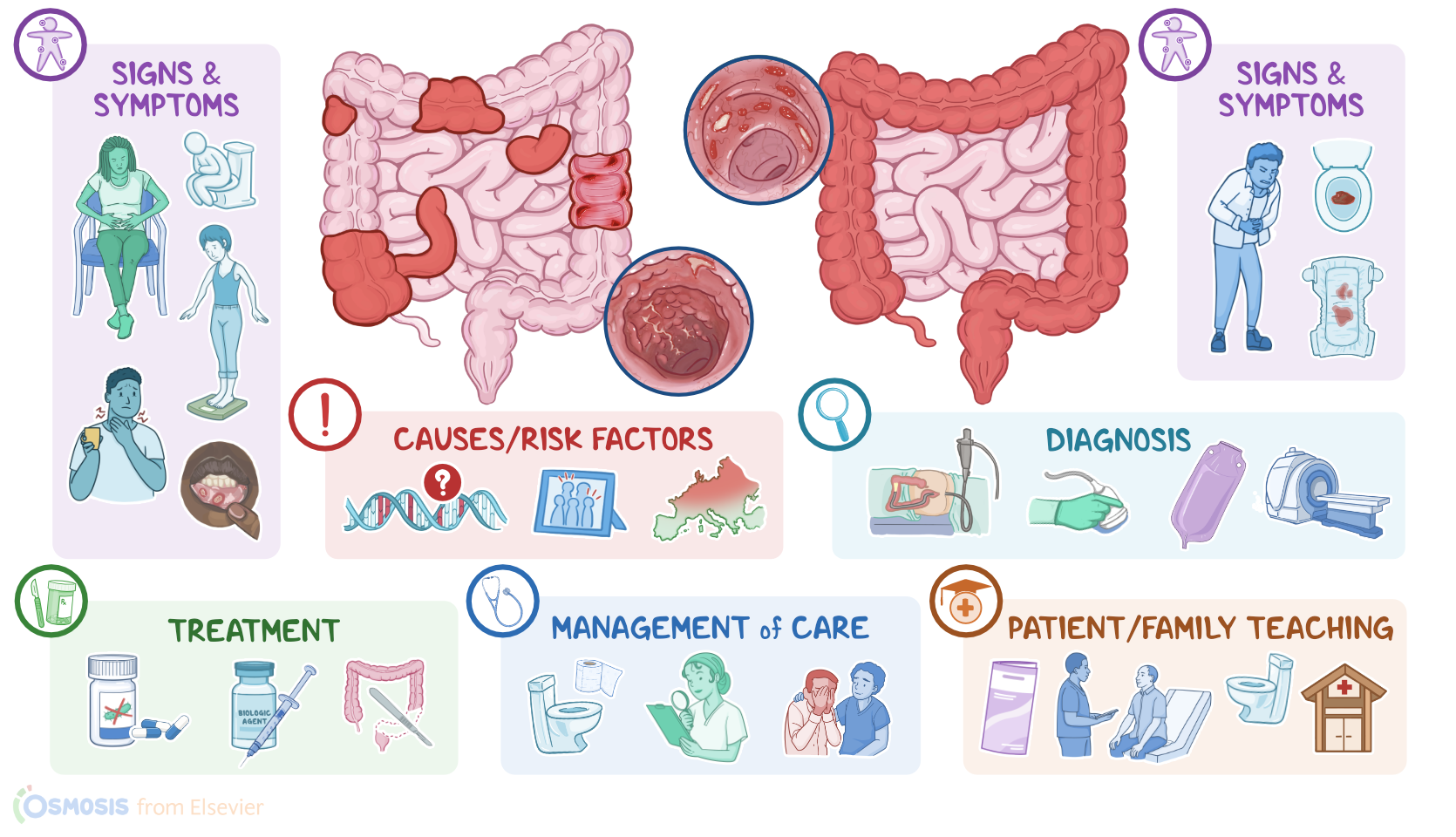
Inflammatory bowel disease or IBD is a condition characterized by chronic gastrointestinal tract inflammation due to autoimmune reactions, as well as systemic symptoms like fatigue, fever, and unintentional weight loss. There are two types of IBD, Crohn disease and ulcerative colitis.

The gastrointestinal tract consists of a long tube, where food travels through, which runs from the mouth to the anus.

Now if we zoom into a cross-section of the gastrointestinal tract, the walls are typically lined by the same four layers of tissue. From the inside out, there’s the mucosa, which absorbs nutrients and secretes mucus and digestive enzymes; the submucosa, a dense layer of tissue that contains blood vessels, lymphatics, and nerves; the muscularis externa, which contracts to move food through the bowel; and the outermost layer is either the adventitia or the serosa, and faces the abdominal or peritoneal cavity.

So when we eat a big meal, the food travels from the mouth, down the pharynx and esophagus, to reach the stomach, which has a handful of glands that secrete hydrochloric acid and pepsin to help digest the food, now called a bolus.

Then the bolus passes towards the small intestine, or small bowel, made of the duodenum, jejunum, and ileum, where nutrients are absorbed. Examples are - monosaccharides, amino acids, fatty acids, electrolytes, minerals, vitamins, and water.

To increase the surface for absorption, the mucosa in the small intestine has lots of tiny ridges and grooves, each of which has little finger-like projections called villi. And in turn, each villus is covered in tiny little microvilli. Then, whatever isn’t absorbed travels to the large intestine, made of the cecum, colon, rectum, and anal canal.

Here, there are trillions of bacteria, collectively called the gut microbiome, which help produce essential B and K vitamins. Now, in the large intestine, a little more water and electrolytes are absorbed to finally form the feces that are eliminated through the anus.

Now, the exact cause of IBD is unknown, but there’s a genetic component because it runs in families. So, risk factors include family history, northern European descent, and the presence of genetic and inflammatory disorders like cystic fibrosis, psoriasis, or multiple sclerosis.

In addition, smoking and Ashkenazi Jewish descent are associated with an increased risk for Crohn disease.

Now, the pathology of inflammatory bowel disease starts in the gastrointestinal tract of a genetically susceptible client when the immune system is triggered by an antigen. initiating an excessive inflammatory response. This ends up damaging the mucosal epithelium, which provides a perfect environment for bacteria to invade and grow.

More immune cells come to the scene, and release cytokines, that cause further inflammation and damage. In Crohn disease, the inflammation can occur anywhere from the mouth to the anus.

They appear most commonly in the terminal ileum and colon, but usually spares the rectum. There’s typically large areas of healthy tissue in between damaged areas, so they’re called “skip lesions.”

The lesions caused by the inflammation involve the entire depth of the intestinal wall, which is referred to as being transmural. These deep lesions and ulcers often run longitudinally along the tissue with sections of normal mucosa in between, thus creating a “cobblestone” appearance.

On the flip side, with ulcerative colitis, the inflammation most often starts at the rectum, and spreads continuously along the large intestine. The damage is limited to the mucosa and submucosa of the intestinal wall. Over time, both Crohn disease and ulcerative colitis may lead to several complications.

With both Crohn disease and ulcerative colitis, there might be acute or chronic bleeding and anemia due to iron deficiency. Sometimes, a phlegmon can form, which is where there’s a localized area of inflammation in the intestinal wall that can get infected and become an abscess.

Now Crohn disease can result in strictures, which may eventually cause bowel obstruction. Other complications include micro-perforations and fistulas, which are communications between two epithelial organs.

If the small intestine is affected, there’s reduced absorption of bile salts which increases the risk of gallstones.

Decreased fat absorption will cause the excess fat to bind to calcium in the small intestine. This prevents oxalate from binding to the calcium so they’re absorbed into the body and increase the risk of developing calcium-oxalate kidney stones.

Now, ulcerative colitis is more likely to cause toxic megacolon as a complication but this could also occur in Crohn disease. This is where the nerves and muscles are damaged and the colon becomes atonic and dilated. This results in stool build up and the colon becomes dilated. In severe cases, it can lead to perforation with peritonitis.

Other conditions that often occur with ulcerative colitis include inflammatory arthritis, such as ankylosing spondylitis, skin lesions like pyoderma gangrenosum and erythema nodosum, as well as primary sclerosing cholangitis, which is when there’s fibrosis and inflammation of both the intra- and extrahepatic bile ducts.

Finally, clients with inflammatory bowel disease are at increased risk for developing colorectal cancer.

In Crohn disease, gastrointestinal symptoms include crampy abdominal pain, watery diarrhea that may or may not be bloody, and sometimes malabsorption symptoms like steatorrhea, or B12 deficiency, causing malnutrition as well as weight loss.

A very frequent finding are aphthous ulcers in the mouth. Some clients may also present esophageal involvement, with odynophagia or painful swallowing, and dysphagia.

Clients with ulcerative colitis usually present with gastrointestinal symptoms that include colicky abdominal pain, which is often relieved after defecation; bloody diarrhea; rectal bleeding; and tenesmus, which is pain when defecating. There may also be malaise, anorexia, and fever.

All right, diagnosis of IBD starts with the client’s history, and physical assessment, followed by endoscopy or colonoscopy with biopsy to confirm the diagnosis. Laboratory tests may also show elevated ESR or PCR and fecal calprotectin, which indicate an inflammatory process in the gastrointestinal tract.

Finally, imaging studies like barium enema, ultrasound, CT, and MRI can be performed to assess the extent of inflammation in and beyond the bowel wall.

Now, the choice of treatment depends on the type and severity of IBD. Usually, treatment involves the use of corticosteroids, methotrexate or 5-aminosalicylic acid, or 5-ASA for short.

An alternative is antibiotics like ciprofloxacin and metronidazole, which are thought to help control symptoms by reducing bacteria levels in the intestine and by curbing the immune response.