Left-sided heart failure: Nursing process (ADPIE)
Client Report0:00–0:31
admitted to the Medical-Surgical floor yesterday. Mr.
Hendrick has a history of chronic left-sided heart failure and hypertension. He was directly admitted by his cardiologist after complaints of shortness of breath, dry cough, and severe fatigue.
He states his last hospitalization was around 6 months ago for similar symptoms. is when the heart is unable to pump effectively enough to maintain cardiac output to meet the demands of the body.
Pathology0:31–5:23
Common risk factors for heart failure include uncontrolled hypertension, ischemic heart disease, valvular heart disease, cardiomyopathy, endocarditis, and acute myocardial infarction.
The onset of heart failure can be acute, which occurs suddenly and resolves in a short period of time, but usually develops slowly over a long period of time and persists as a chronic disease.
Often an individual can live with chronic heart failure, but then suddenly develop an acute exacerbation. which is due to inadequate contractility, or diastolic dysfunction, when the heart is unable to relax and fill with blood.
Heart failure can affect the right side, the left side, or both sides of the heart. The left and right sides of the heart are two separate pumping systems, and one side can remain functional for some time even if the other side is failing.
Most cases of heart failure initially start on the left side, and then eventually progress to include both sides. pump with enough force to push blood into the aorta and the rest of the body.
When this happens, the blood remaining in the left side of the heart will back up into the lungs, causing pulmonary problems such as dyspnea, tachypnea, crackles, dry cough, paroxysmal nocturnal dyspnea, pulmonary edema, and pulmonary hypertension.
Pulmonary edema is a life-threatening emergency where the lungs fill up with fluid causing very high pressure. Someone with pulmonary edema will present with a large amount of blood-tinged frothy sputum, severe dyspnea, tachycardia, profuse sweating, and cyanosis.
to move blood forward into the lungs, causing it to back up into the superior and inferior vena cavae and the rest of the venous system.
Right-sided heart failure is almost always caused by left-sided heart failure, because increased pulmonary pressure from blood backing up into the lungs from the left side makes it more difficult for the right side to pump blood into the lungs.
As the right side works harder to overcome the increased pressure it eventually wears out and fails. Symptoms of right heart failure include dependent edema, jugular venous distension, abdominal distension, splenomegaly, anorexia, weight gain, nocturnal diuresis, and hypertension or hypotension.
decreased cardiac output. Through the Frank-Starling mechanism, myocardial contractility is increased, which helps push blood forward.
The sympathetic nervous system also responds by increasing heart rate, increasing peripheral vascular resistance, and further enhancing cardiac contractility.
Sodium and water is retained through the actions of the renin-angiotensin-aldosterone system, which provides additional circulating volume.
The ventricular cells, or myocytes, undergo remodeling, resulting in changes such as increased muscle mass and thickening of the ventricular wall.
These compensatory efforts will initially lead to an increase in cardiac output, but over time the heart will be overburdened and less efficient.
When this happens, clinical symptoms of heart failure will appear. Without treatment, heart failure will progress and result in complications such as pleural effusion, cardiac dysrhythmias, and renal failure.
Assessment5:23–8:22
Upon entering Mr. Hendrick’s room, you introduce yourself, confirm his identity, and wash your hands.
You begin your assessment of Mr. Hendrick by asking him how he is feeling today.
He tells you he feels short of breath, but better than when he was admitted. Mr.
Hendrick goes on to say he is extremely tired today, and that he has been feeling fatigued for several days. You ask Mr.
Hendrick what caused him to start feeling short of breath, and he replies he just walked to the bathroom. You notice he pauses several times during your chat to cough, but it’s non-productive.
You ask Mr. Hendrick if he has issues breathing at night, he replies he wakes up every night with difficulty breathing and that he sleeps better in his recliner.
You ask Mr. Hendrick if he has been using the bathroom regularly, he states he has been urinating less than normal.
You check the bedside portable urinal and document 30 milliliters of clear yellow urine. Hendrick, you notice that in addition to appearing slightly short of breath, nasal flaring is present, he’s using his accessory muscles to breathe, and he’s diaphoretic.
You auscultate his lungs and hear wheezing on inhalation and crackles throughout both lobes. You assess capillary refill and note that it is decreased.
Skin color and turgor are normal. Mr.
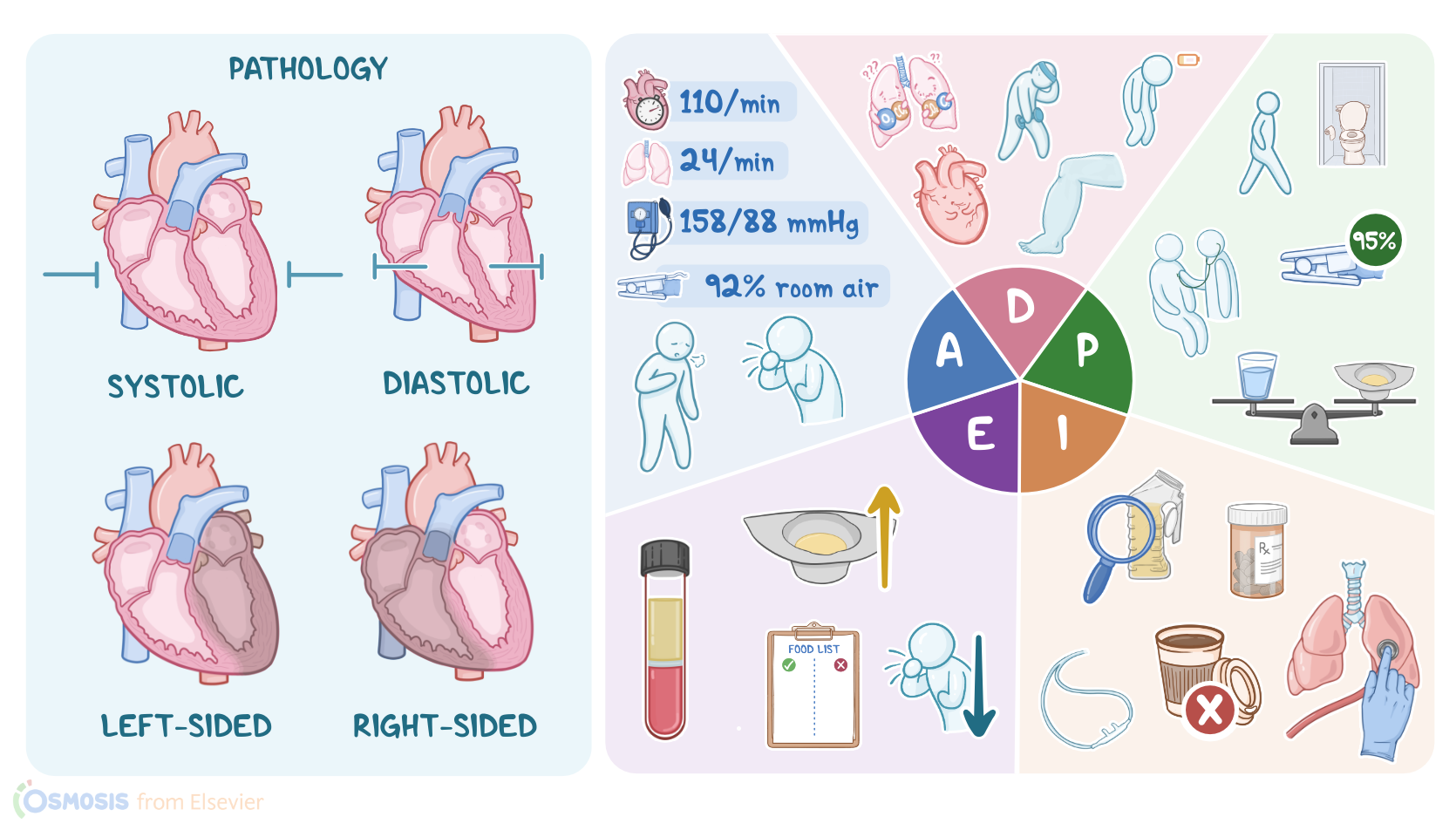
Hendrick’s vital signs are HR: 110, RR: 24, BP: 158/88, oxygen saturation: 92% on room air, oral temp.: 98.2° F, pain: 0/10.
Next, you review his recent lab results and note the following: creatinine: 1.6 mg/dl, BUN: 30 mg/dl, BNP: 150 pg/mL, hemoglobin: 14 g/dL, sodium: 132 mEq/L, chloride: 92 mEq/L.
Finally, you check his recent diagnostic tests: electrocardiogram showing normal sinus rhythm, chest X-ray showing mild left ventricle enlargement, echocardiogram from 3 years ago showing an ejection fraction of 45%.
Finally, you document all your assessment findings before leaving the room. the diagnoses include: Impaired gas exchange related to alveolar-capillary changes, decreased cardiac output related to altered myocardial contractility, activity intolerance related to an imbalance of oxygen supply/demand, excess fluid volume related to decreased cardiac output, and fatigue related to decreased oxygenation.
Diagnosis8:22–8:53
Planning8:53–9:42
Hendrick, you set a few goals in his plan of care. These include a decrease in periods of dyspnea, with him being able to tolerate more activity like ambulating to the bathroom without feeling short of breath within 24 hours; clear breath sounds and stable vital signs, with an oxygen saturation of 95% while on room air by the day of discharge, and a balance in fluid intake and output by the time of discharge.
Finally, he’ll understand the risk factors for exacerbations of his chronic left-sided heart failure, be able to avoid causative factors, and be able to verbalize how to make appropriate dietary choices by the time of discharge.
Implementation9:42–11:59
Hendrick will need strict I&Os, and you delegate this task along with basic care needs to the nursing assistant. Monitoring Mr.
Hendrick’s fluid status is very important, and you ask the nursing assistant to notify you if Mr. Hendrick has any issues urinating or his urine output is below normal.
Since Mr. Hendrick has a low oxygen saturation of 92%, you apply a nasal cannula at 2 liters per minute to keep his oxygen saturation above 95%.
You focus on lung sound assessment to monitor the degree of fluid in the lungs. His prescriptions include furosemide, lisinopril, carvedilol, and digoxin to help with his cardiac output and excess fluid volume.
You provide education on the uses, side effects, and importance of each medication, and administer them as ordered. Then, you sit down and review important dietary recommendations for Mr.
Hendrick in order to prevent further exacerbations of his heart failure. You help him understand he needs to avoid large amounts of caffeine, like coffee, tea, cocoa, and chocolate, and you explain how a low sodium diet helps with blood pressure control and with maintaining appropriate fluid volume.
You also help him identify food he enjoys while adhering to a low cholesterol and low-fat diet. You’ll review the fluid restrictions prescribed by his doctor, and explain that he should spread the fluid he drinks throughout the day.
Instruct him to weigh himself at the same time each day, and to let his physician know of any swelling or weight change of more than 3 lbs.
You help Mr. Hendrick understand how important these lifestyle changes are to help prevent any complications with his heart failure.
Finally, before leaving the room, you check that all physician orders for labs and medications are inputted correctly so Mr.
Hendrick can continue to receive care. it’s time to evaluate how Mr.
Evaluation11:59–14:04
Hendrick is doing. The nursing assistant informs you Mr.
Hendrick has had a slight increase in his urine output today, averaging around 40-50 milliliters per hour. You reassess Mr.
Hendrick’s lung sounds, and determine he is not wheezing and that crackles are only present in the right lower lobe.You ask him if he is still feeling short of breath when walking to the bathroom.
He is, but he can walk a little further before he starts feeling short of breath. Upon visual inspection, he’s no longer using his accessory muscles to breathe, but he does still have some nasal flaring.
Mr. Hendrick only coughed once while you were in his room.
Even though discharge will not be for at least another 24 hours, you recognize it’s important that his cardiac output has improved, and the excess fluid volume has decreased.
Most recent vital signs are HR: 95, RR: 20 BP: 142/82; oxygen saturation: 94% on nasal cannula at 2 liters/minute; oral temp.: 98.2° F.
Mr. Hendrick verbalizes important dietary guidelines he’ll adhere to from now on.
His latest lab work has not returned yet, but you’ll continue to monitor the BNP, creatinine and BUN levels. By continuing to re-assess, re-evaluate, and document outcomes, you’ll be able to determine if the goals you set have been met, or if changes should be made to his plan of care.
If there are any signs of his heart failure worsening, such as an increase in his shortness of breath, frothy sputum, or a return of the crackles in his lungs, you’ll notify his health care team immediately.
Summary14:04–15:39
Mr. Hendrick, had an acute exacerbation of his chronic left-sided heart failure.
Left-sided heart failure is when the left ventricle is unable to pump with enough force to push the blood into the aorta, and outward into the rest of the body.
Left-sided heart failure will present with pulmonary symptoms such as dyspnea, crackles, and dry cough. It’s typically caused by coronary artery disease, myocardial infarction, and uncontrolled hypertension.
Your assessment of Mr. Hendrick revealed shortness of breath, nasal flaring, use of accessory muscles, low oxygen saturation, decreased urinary output, and the presence of wheezing and crackles in the lungs.
Your nursing diagnosis centered around the physical manifestations of impaired gas exchange, decreased activity tolerance, and decreased cardiac output.
The goals of the plan of care were to resolve his physical symptoms, to restore Mr. Hendrick to his optimal quality of life, as well as educate him on the different lifestyle and dietary changes he must implement to prevent further deterioration of his heart failure.
Along with the nursing assistant, you work to implement actions to achieve the goals of the plan of care. Throughout your shift, and up until Mr.
Hendrick’s discharge, you along with the healthcare team will evaluate if those
| LEFT-SIDED HEART FAILURE | ||
| KEY POINTS | NOTES | |
| PATIENT REPORT |
| |
| PATHOPHYSIOLOGY |
| |
| ASSESSMENT |
| |
| NURSING DIAGNOSES |
| |
| PLANNING |
| |
| IMPLEMENTATION |
| |
| EVALUATION |
| |
No notes for this video yet
Try adding a note below